Ketamine-Associated Uropathy (Ketamine Cystitis)
Ketamine-associated uropathy, also called ketamine cystitis or ketamine-induced uropathy, is a chronic inflammatory and fibrosing injury of the urinary tract in people who use ketamine regularly for recreation. It presents with frequency, urgency, dysuria and suprapubic pain, sometimes with painful hematuria, and with a small, poorly compliant bladder; hydronephrosis can follow from ureteral involvement, vesicoureteral reflux or the contracted bladder itself.[1][2][3] Cessation of ketamine is the first step of treatment. Lower urinary tract symptoms usually improve after cessation and return when use resumes.[1][3]
The condition produces end-stage contracted bladders in young adults. A pooled review of 23 publications (875 patients) found that 193 (22%) had undergone reconstructive surgery, most often augmentation enterocystoplasty, and that surgical and nonsurgical patients differed by only about one year of ketamine use, which the authors read as rapid progression to end-stage bladder.[4] Operative technique is on Supratrigonal Cystectomy, Augmentation Cystoplasty and Ileocystoplasty; the overlapping bladder pain syndrome is on Interstitial Cystitis / Bladder Pain Syndrome.
Recreational and Therapeutic Ketamine
The published uropathy literature describes recreational use. Therapeutic exposure is a separate question with separate evidence.
- Recreational use. In the augmentation series from Hann-Chorng Kuo's group at Hualien Tzu Chi Hospital (Taiwan), every patient had snorted at least 3 g per dose, twice a week, for at least 6 months.[5] In an online survey promoted through a dance-music magazine, 1,285 of 3,806 respondents had used ketamine in the previous year, and 340 of these recent users (26.6%) reported urinary symptoms; symptoms were related to both dose and frequency of use.[6] In a Hong Kong community screening study, use more than 3 times weekly was associated with lower voided volumes, and use for more than 24 months with higher Pelvic Pain and Urgency/Frequency (PUF) scores (7.82 compared with 6.00).[7] In a questionnaire study of 106 users at two Taiwanese rehabilitation centers (95 men; mean age at first use 16.7 years), 89 (84%) developed lower urinary tract symptoms after a mean of 24.7 months of use; all symptom scores correlated with duration of use, and snorting was associated with more severe symptoms than smoking.[8]
- Therapeutic use. Ketamine is used for anesthesia, perioperative analgesia (see Analgesia) and treatment-resistant depression. A systematic review of 27 studies of ketamine for psychiatric disorders found urological symptoms in 0% to 24.5% of treated patients, mostly mild or moderate, with no significant change in urinary parameters or symptom questionnaires where these were measured; only 15% of studies were at low risk of bias, and most did not assess long-term treatment.[9] A 2025 review notes that, in the 14 randomized trials within a 27-study systematic review, urological symptom rates differed little between ketamine and comparison arms, and finds no convincing evidence of uropathy in therapeutic settings.[10] The same review lists higher dose, more frequent dosing, longer treatment and oral administration as potential risk factors during maintenance therapy, and suggests high fluid intake and frequent voiding on treatment days, with fortnightly or monthly urine testing.[10]
- Topical and intravaginal ketamine for pelvic pain is discussed on Myofascial Pelvic Pain.
Epidemiology
The first reports, in 2007, described 9 daily users with severe ulcerative cystitis in Toronto and 10 young users with contracted bladders at two Hong Kong hospitals.[11][12] Ketamine had entered Hong Kong as a club drug in 2000.[13] A UK unit identified 81 patients over 11 years, a large proportion presenting from 2018 onward; mean age at presentation was 26 years and 72.8% were men.[14] In a tertiary reconstructive unit, 44 patients (68% men) had a mean age of 31 years.[15]
Reports from continental Europe describe a rising burden. At the first Dutch outpatient clinic dedicated to ketamine-induced uropathy, the number of patients treated rose from zero in 2018 to 137 in 2024; patients reported use of more than 1 g/day for a median of 35 months, 51 developed severe uropathy requiring surgery, and 3 ultimately had cystectomy with urinary diversion.[16] Ketamine-related cases reported to the French Addictovigilance Network rose 16-fold between 2019 and 2023 (411 cases, median age 23 years); 36 involved urinary tract toxicity, several requiring cystectomy and bladder reconstruction.[17] In the Crime Survey for England and Wales, last-year ketamine use among 16- to 24-year-olds rose from 1.7% in the year ending March 2010 to 3.2% in the year ending March 2020, the highest estimate the survey had recorded.[18] It was 2.0% in the year ending March 2025, not significantly different from 2015, while use among 16- to 59-year-olds rose from 0.5% in the year ending March 2015 to 0.8%.[19]
Prevalence estimates depend on how cases are found. A review of the therapeutic literature cites a meta-analysis of 37 studies in recreational users with prevalences of 44% to 77% for lower urinary tract symptoms and 8% to 30% for upper-tract disease, judges these figures potentially misleading, and notes lower estimates (2% to 27%) in more recent studies that used different case ascertainment.[10] A 2022 meta-analysis of 45 articles (4,921 patients) reported pooled prevalences of frequency 77.1%, urgency 69.9%, suprapubic pain 60.4% and hydronephrosis 30.2% (95% CI 22.0% to 39.2%).[2]
Pathophysiology
Injury is attributed to ketamine and its metabolites in urine, not in the circulation.[10] Proposed mechanisms, drawn from human tissue and animal studies, include:[20][3]
- Urothelial barrier disruption. Antiproliferative factor, ATP and oxidative stress.
- Lamina propria inflammation and fibrosis. Cyclooxygenase-2, nitric oxide synthase, IgE and transforming growth factor β1.
- Microvascular injury. NMDA receptor signaling, tumor necrosis factor α and vascular endothelial growth factor.
- Detrusor dysfunction. Depressed Akt, ERK, Cav1.2 and muscarinic signaling, with increased purinergic (P2X1) responses. In experimental studies, ketamine inhibits the L-type calcium channel Cav1.2 and smooth-muscle contractility, and smooth-muscle Cav1.2 inactivation reproduces the cystitis phenotype.[21]
- Neural changes. NMDA receptor and brain-derived neurotrophic factor signaling.
Individual experimental findings support several of these pathways. In normal human urothelium in organ culture and in vitro, ketamine caused apoptosis with cytochrome c release and caspase activation, and the cells expressed no NMDA receptor transcript, which points to direct, receptor-independent toxicity.[22] In rats, long-term ketamine reduced zonula occludens-1 expression in the bladder wall, consistent with a defective epithelial barrier,[23] and coadministration of the COX-2 inhibitor parecoxib prevented ketamine-induced bladder hyperactivity and loss of capacity and reduced interstitial fibrosis.[24] In bladder biopsies from 36 patients, mucosal microvessels showed basement-membrane duplication, and endothelial cells coexpressed a mesenchymal marker.[25]
A hypersensitivity component is suggested by serum IgE. In 20 patients with ketamine cystitis, median serum IgE (205.5 IU/mL) was higher than in controls and in acute bacterial cystitis and marginally higher than in IC/BPS (p = 0.029); higher IgE and more eosinophil infiltration were associated with more pain and smaller maximal bladder capacity.[26] The ICI-RS 2024 review notes that fibrosis, usually regarded as irreversible, may be partly modifiable, but that the timing of its onset and its effect on long-term outcome are not established.[3]
Histology shows urothelial denudation and inflammation with eosinophils.[11] All bladder biopsies in one reconstructive series showed an eosinophilic infiltrate, and all 12 available biopsies in a Hong Kong series resembled interstitial cystitis.[15][27] Ketamine can also produce reactive urothelial atypia that must be distinguished from intraepithelial neoplasia; a pathology review notes that p53, cytokeratin 20 and CD44 immunohistochemistry help separate reactive urothelium from carcinoma in situ after such injury.[28]
Clinical Presentation and Assessment
All 59 patients in a Hong Kong series had moderate to severe lower urinary tract symptoms (frequency, urgency, dysuria, urge incontinence and occasionally painful hematuria) without evidence of bacterial infection.[27] Urine cultures were sterile in all 9 patients of the first Toronto series.[11] In the 2022 meta-analysis, pooled functional bladder capacity was 95.23 mL, voided volume 113.31 mL and maximum flow rate 8.69 mL/s.[2] In 36 patients with at least 6 months of exposure who underwent urodynamics, mean cystometric capacity was 65.4 mL.[25]
Assessment in reported series includes:
- Drug history. Quantity, frequency, route, duration and current abstinence. At first consultation in a prospective Hong Kong cohort, 207 of 572 patients (36.2%) were already abstinent.[29]
- Symptom scores and voiding diary. PUF score is the instrument most series use.[7][30][31]
- Urinalysis and culture to exclude infection.[11]
- Uroflowmetry and post-void residual.[29]
- Renal ultrasound, serum creatinine and liver enzymes. The Hong Kong cohort performed ultrasonography at first consultation and collected renal and liver function tests (see Upper-tract involvement).[29][3] Renography can show impaired cortical uptake with a slowly rising MAG3 curve, or cortical scarring on DMSA.[32]
- Cystoscopy shows ulcerative cystitis.[1] In 42 of 59 patients (71%), cystoscopy showed epithelial inflammation similar to that of interstitial cystitis.[27]
- CT urography maps bladder and ureteral wall thickening and fistula (see below).[33] In one case report, asymmetric bladder wall thickening on CT suggested bladder cancer until biopsy showed severe inflammation without malignancy.[34]
- Video-urodynamics before reconstruction. In 47 patients studied, all had detrusor overactivity or decreased compliance, with or without reflux.[27] The Hualien group obtains video-urodynamics before and 3 to 6 months after augmentation.[35][5] See Urodynamics.
Distinction from IC/BPS. Ketamine-associated uropathy belongs in the differential diagnosis of ulcerative cystitis, and the drug history separates it from IC/BPS.[1] Serum IgE was higher in ketamine cystitis than in IC/BPS in one small comparison, but not significantly at the study's corrected threshold.[26]
Upper-Tract Involvement
Reported hydronephrosis rates vary with the population studied:
| Population | n | Hydronephrosis |
|---|---|---|
| Meta-analysis, pooled | 45 articles | 30.2% (95% CI 22.0% to 39.2%)[2] |
| Prospective cohort, Hong Kong | 572 | 96 (16.8%)[29] |
| UK single center | 81 | 20 (24.7%); nephrostomy in 6[14] |
| Hong Kong referral series | 59 | 30 (51%); papillary necrosis features in 4 (7%); raised creatinine in 8[27] |
| CT urography series, Taipei | 27 | 12 (44.4%)[33] |
Mechanisms. Hydronephrosis is associated with the contracted bladder, ureteral stenosis and vesicoureteral reflux from ureteral involvement or bladder fibrosis.[1] On CT urography in 27 patients, findings included diffuse bladder wall thickening (88.9%), small bladder volume (66.7%), perivesical inflammation (44.4%), ureteral wall thickening (9 patients, 33.3%) and ureterovesical junction involvement without ureteral thickening (2 patients); 4 patients (14.8%) had a vesicovaginal fistula that was visible only in the excretory phase. Upper-tract involvement did not correlate with the cystoscopic grade of cystitis.[33] For fistula repair see Vesicovaginal Fistula.
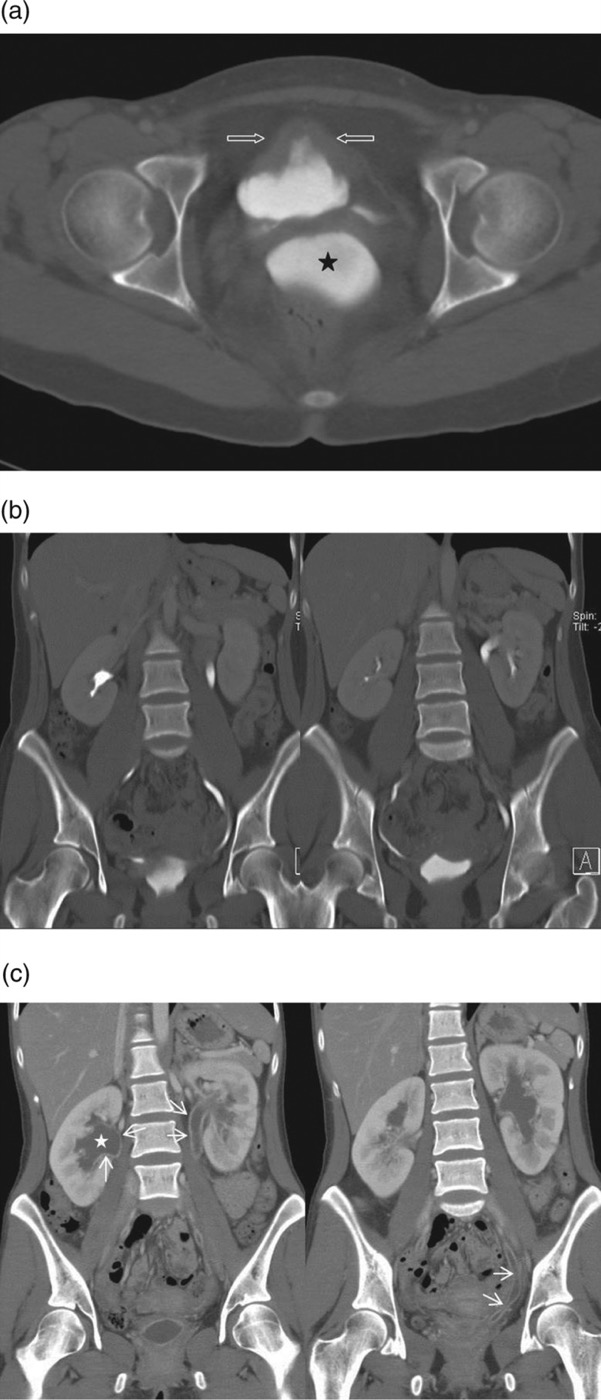
CT urography in a 24-year-old woman with a 2-year history of ketamine use. (A) Combined nephrographic and excretory phase: bladder wall thickening (open arrows), a small bladder volume and contrast in the vagina from a vesicovaginal fistula (black star). (B) Coronal reformat of the same study, without hydronephrosis. (C) Three-phase CT urography 6 months later: dilated ureters and collecting systems (white star) with diffuse mucosal enhancement (arrows), showing rapid upper-tract progression. From Huang LK, et al. Postgrad Med J. 2014;90(1062):185-190, Figure 1 (CC BY-NC 3.0).[33]
Predictors. In the 572-patient cohort, logistic regression associated hydronephrosis with age (adjusted OR 1.090), lower functional bladder capacity (adjusted OR 0.997 per mL), serum creatinine above 100 μmol/L (adjusted OR 3.107) and an abnormal liver enzyme profile (adjusted OR 1.967).[29] Serum gamma-glutamyl transferase was higher in UK patients with hydronephrosis.[14] The ICI-RS 2024 review notes that advanced disease does not always correlate with the severity of lower urinary tract symptoms and recommends attention to liver enzymes.[3] Chronic ketamine use also causes multiple irregular biliary strictures with intrahepatic and extrahepatic duct dilatation, seen with or without the uropathy;[32] 8 of 411 cases in the French surveillance series involved cholangitis or cholestasis.[17]
Renal outcome. In a retrospective single-center cohort of 51 patients (Kaohsiung, Taiwan), 22 with ketamine-associated hydronephrosis and 29 with cystitis alone, the renal endpoint (end-stage renal disease or a decline in estimated glomerular filtration rate of more than 30% from baseline) was reached by 50% of the hydronephrosis group and 7% of the cystitis group (p < 0.001). Hydronephrosis remained an independent risk factor after adjustment for age, sex and initial creatinine, and alkaline phosphatase and gamma-glutamyl transferase were higher in the hydronephrosis group.[36]
Management. Nephrostomy was required in 6 of 81 patients in the UK series.[14] Upper-tract compromise from a high-pressure contracted bladder, and ureteric obstruction, are indications for reconstruction.[15] Ureteral disease can progress after bladder surgery. In one case, ureteritis led to bilateral obstruction and renal failure after subtotal cystectomy and orthotopic reconstruction, and was managed with bilateral renal autotransplantation with pyelovesicostomy.[37] See also Ureteral Stricture.
Staging
Wu and colleagues proposed a three-stage clinical model from a retrospective review of 81 hospitalized patients (Guangzhou, 2008 to 2014). Patients were staged by ketamine history, renal and liver function, bladder changes and upper-tract involvement; 24, 47 and 10 patients fell into stages I, II and III, and cross-validation classified 83.1% correctly.[31] Duration of use correlated with stage (r = 0.268). Creatinine, estimated glomerular filtration rate and liver function were worse, and ureteral changes and hydronephrosis more frequent, at higher stages, whereas the severity of lower urinary tract symptoms did not differ significantly between stages.[31]
| Stage | Treatment in the Wu series | n treated |
|---|---|---|
| I | Behavioral modification and pharmacotherapy | 24 |
| II | Hydrodistension | 35 |
| III | Surgical intervention, for rapid progression after conservative therapy | 6 |
All three groups improved in voided volume, micturition interval, nocturia and PUF score after treatment. The authors state that the model still requires external validation.[31]
The Hualien group selects for augmentation by maximal bladder capacity: an extremely small capacity (<100 mL) with or without upper-tract damage, or a very small capacity with upper-tract damage.[38]
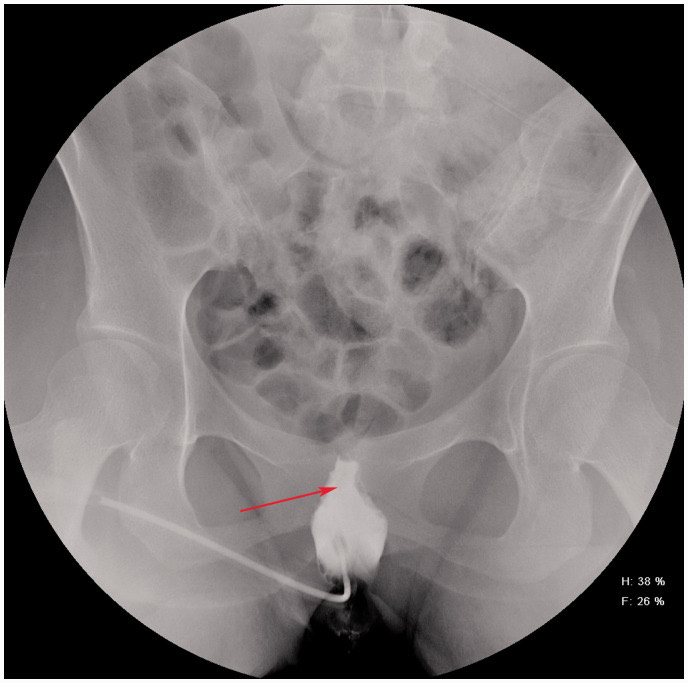
Cystogram in ketamine-associated cystitis showing a small-capacity, tower-shaped contracted bladder (red arrow). From Li B, et al. J Int Med Res. 2020;48(11):300060520973100, Figure 3 (CC BY-NC 4.0).[39]
Nonoperative Management
Abstinence and multidisciplinary care
- Of 251 survey respondents who described their symptoms over time, 51% reported improvement after stopping ketamine and 8 (3.8%) reported deterioration.[6] In the Taiwanese rehabilitation-center survey, 81 users (83.5%) reported improvement after cessation, with urinary frequency the first symptom to improve.[8]
- After 1 year of abstinence, PUF scores were lower and voided volumes higher than in active users; the authors conclude that early functional changes may normalize.[7]
- Relapse usually brings symptoms back. Hong Kong authors describe multidisciplinary care as necessary because of the psychological and social factors behind use and abstinence.[13] Psychological dependence on ketamine complicates cessation.[3]
- Follow-up adherence is poor in some populations.[14]
Oral therapy
The four-tier protocol of the Youth Urological Treatment Centre, Prince of Wales Hospital, Hong Kong, moves from anti-inflammatory or anticholinergic drugs to opioid analgesics or pregabalin, then intravesical hyaluronic acid, and finally surgery, including hydrodistension and augmentation cystoplasty.[13][30] In this prospective case series of 463 patients (December 2011 to June 2014), 319 returned for follow-up (mean 10.7 ± 8.5 months). The 290 patients treated with first-line drugs improved in PUF score, EuroQol visual analog scale and functional bladder capacity, and abstinence and the amount of ketamine consumed predicted PUF improvement. Of 62 patients who needed second-line oral therapy, 42 (67.7%) reported improvement; 8 had completed intravesical therapy at the time of reporting.[30] Pentosan polysulfate with cessation gave some relief in the first Toronto series.[11]
Intravesical and endoscopic therapy
- Hyaluronic acid instillation is the third tier of the Hong Kong protocol.[30] A single case report describes 10 weekly instillations after failed oral therapy, with capacity rising from less than 100 mL to 350 mL per void and reversal of the bladder wall thickening on MRI and biopsy.[34] See Intravesical Agents.
- Intradetrusor botulinum toxin A. In a randomized comparison of 36 patients, 200 U onabotulinumtoxinA and cystoscopic hydrodistension were each combined with eight hyaluronic acid instillations; at 12 months, daytime frequency, Interstitial Cystitis Symptom Index, maximal capacity and maximal cystometric capacity were better in the botulinum toxin group. Persistent involuntary detrusor contraction at 6 months was associated with longer ketamine use, more fibrosis on pathology and lower capacity.[39] A single-center series of 36 patients treated with botulinum toxin A plus hydrodistension after failed antimuscarinic or antibiotic therapy reported improvement at 1 month.[40] In a reconstructive unit, 4 patients had repeated injections with minimal subjective relief, and 2 of them proceeded to major reconstruction.[15] See Intradetrusor OnabotulinumtoxinA.
- Hydrodistension is the stage II treatment in the Wu model.[31]
- Bladder autoaugmentation by transurethral vesicomyotomy (BATV). In a retrospective single-center comparison (53 patients, 2014 to 2019, minimum 1-year follow-up), 12 patients had BATV and 41 had hydrodistension. Maximum cystometric capacity at 12 months was 281.0 mL after BATV and 213.5 mL after hydrodistension (p < 0.001); symptom relief and complication rates were similar.[41] Open and laparoscopic detrusorotomy are covered on Autoaugmentation.
- Self-reported responses. In the Taiwanese rehabilitation-center survey, 51 users (48.1%) had sought no treatment. Among those treated, reported response rates were 26 of 49 (53%) for oral medication, 10 of 14 for hydrodistension, 5 of 7 for hyaluronic acid instillation, 2 of 2 for botulinum toxin injection and 1 of 3 for hyperbaric oxygen therapy.[8]
Reconstruction
Indications
In the reconstructive-unit series, indications for major reconstruction were intractable symptoms, high-pressure loss of compliance with renal compromise, and ureteric obstruction.[15] In the Hualien series, augmentation was offered for severe bladder pain, urgency and frequency with a contracted bladder, with or without upper-tract damage such as bilateral hydronephrosis, after at least 1 year of conservative treatment.[35] In a comparison of 28 patients who underwent augmentation and 25 who continued conservative treatment after initial failure, the augmentation group had smaller maximal capacity, thicker bladder walls and more reflux at baseline; augmentation outcomes were reported as good, and conservative outcomes as mostly fair.[38]
Over half the patients in the pooled surgical review already had hydronephrosis or reflux at reconstruction (hydronephrosis or ureteral obstruction in 44 of 86, reflux in 25 of 68). The authors argue that reconstruction is best done before these develop, and that low capacity, low compliance, reflux and hydronephrosis are unlikely to resolve with cessation alone.[4]
Abstinence before and after surgery
- One reconstructive unit advised a minimum of 6 months of abstinence before considering surgery.[15] No study compares abstinence intervals.
- In the 26-patient Hualien series, every patient who stopped ketamine was free of bladder pain after augmentation; 10 who resumed use had recurrent bladder pain and recurrent urinary tract infection.[5]
- In the pooled review, pain persisted after surgery in 16 of 69 patients (23%), and all of them reported relapse of ketamine use.[4]
Choice of operation
In the pooled review, the primary operations in 193 patients were enterocystoplasty (124, 64%), ureteroneocystostomy (15, 8%), BATV (12, 6%), neobladder (10, 5%), continent urinary stoma (8, 4%) and urinary diversion (6, 3%); some patients had combined procedures.[4]
- Augmentation enterocystoplasty, with or without partial or supratrigonal cystectomy. Augmentation is the operation most series report.[1][4] The Hualien group concludes that partial cystectomy with augmentation is needed for a contracted, small-capacity bladder with irreversible change.[38] Partial or supratrigonal cystectomy with enterocystoplasty is listed among the options in the pooled review.[4] Technique, segment choice and supratrigonal compared with subtrigonal resection are on Supratrigonal Cystectomy, Augmentation Cystoplasty and Ileocystoplasty.
- Ureteral reimplantation accompanied augmentation for reflux in the Hualien series and was part of the reconstructive-unit repertoire.[35][5][15] After augmentation with reimplantation, reflux resolved in 5 patients in the first Hualien series and in all reimplanted patients in the second.[35][5] See Ureteral Reimplantation.
- Catheterizable channel. Augmentation with or without a Mitrofanoff channel was used in the reconstructive-unit series, and 19 of 73 patients (26%) with data in the pooled review needed intermittent catheterization after surgery.[15][4] See Principles of Continent Catheterizable Channels.
- Cystectomy with orthotopic neobladder and urinary diversion (ileal conduit) were used in the reconstructive-unit series.[15] See Simple Cystectomy (Benign Disease) and Ileal Conduit. The pooled review could not separate outcomes by operation.[4]
Outcomes
| Series | Design | Patients | Operation | Reported outcomes |
|---|---|---|---|---|
| Chung, Wang and Kuo 2014[35] | Pilot series, Taiwan | 14 (10 women); mean age 26.7 years; ketamine use 3.82 years | Augmentation enterocystoplasty, with ureteral reimplantation for reflux | At 3 to 6 months: pain VAS 8.29 to 2.14; cystometric capacity 50.9 to 309.2 mL; Qmax 6.94 to 15.2 mL/s; Pdet 29.7 to 17.9 cmH2O; hydronephrosis (9 before) resolved in all; reflux (8 before) resolved in 5 after reimplantation |
| Lee, Jhang and Kuo 2017[5] | Retrospective, single center, 2009 to 2014 | 26 (14 women); mean age 28.5 years; ketamine use 4.7 years | Augmentation enterocystoplasty, with reimplantation for reflux | At 3 to 6 months: capacity 52.7 to 327 mL; Qmax 6.94 to 13.7 mL/s; voided volume 44.1 to 250.7 mL; compliance 11.1 to 54; PVR 8.08 to 82.6 mL; hydronephrosis resolved in 7 of 9; reflux resolved in all reimplanted; recurrent pain and UTI in 10 who resumed ketamine |
| Sihra 2018[15] | Retrospective, tertiary reconstructive unit, 2007 to 2017 | 14 of 44 with ketamine uropathy | Ileal conduit, augmentation with or without Mitrofanoff, ureteric reimplantation, cystectomy with neobladder | Complications in 10 of 14: anastomotic leak, ureteric stricture, adhesional small-bowel obstruction, renal failure, sepsis |
| Vizgan 2023[4] | Narrative systematic review, 23 papers of low reported quality | 193 of 875 | Mixed; enterocystoplasty in 64% | Patient-reported success 88 of 110 (78%); reoperation 19 of 110 (17%); major complications 19 of 34 (56%); de novo ureteral obstruction 3 of 28 (11%); mean follow-up 20 ± 9.0 months, reported for 130 patients |
The two Hualien series come from the same institution and overlapping years, so their patients may overlap. Both report 3 to 6 month urodynamic outcomes; neither abstract reports long-term follow-up. The pooled review notes that neither Hualien series reported significant perioperative complications, in contrast to the reconstructive-unit series.[4]
Complications
The reconstructive-unit series found complications in 10 of 14 patients, with no common factor other than ketamine use and the associated inflammation, and recommended meticulous preoperative evaluation and multidisciplinary consultation.[15] The pooled review defined major complications as those requiring reoperation or causing death; 56% of the patients with these data had one, and 11% developed new ureteral obstruction after surgery.[4] Ureteral involvement may continue after bladder reconstruction.[37] The long-term consequences of bowel in the urinary tract (mucus, stones, metabolic change, perforation and malignancy) apply as for any augmentation; see Augmentation Cystoplasty.
Evidence Gaps
- All surgical evidence is retrospective. In the pooled review, success data were available for 57% of operated patients, follow-up for 67%, and the longest follow-up was 35 months.[4]
- No study compares augmentation with supratrigonal excision, augmentation alone, neobladder and diversion in this population, or defines the abstinence interval needed before surgery.
- Ureteral wall thickening is common on CT, and ureteritis can progress after bladder reconstruction.[33][37] Whether the retained trigone and distal ureters limit trigone-sparing reconstruction has not been studied.
- The Wu staging model has not been externally validated.[31]
- Data on long-term or high-frequency therapeutic ketamine are limited.[9][10]
See Also
- Interstitial Cystitis / Bladder Pain Syndrome
- Supratrigonal Cystectomy
- Augmentation Cystoplasty
- Ileocystoplasty
- Ureteral Reimplantation
- Simple Cystectomy (Benign Disease)
- Intravesical Agents
- Hann-Chorng Kuo
References
1. Castellani D, Pirola GM, Gubbiotti M, et al. "What Urologists Need to Know About Ketamine-Induced Uropathy: A Systematic Review." Neurourol Urodyn. 2020;39(4):1049-1062. doi:10.1002/nau.24341
2. Chan EOT, Chan VWS, Tang TST, et al. "Systematic Review and Meta-Analysis of Ketamine-Associated Uropathy." Hong Kong Med J. 2022;28(6):466-474. doi:10.12809/hkmj209194
3. Hervé F, Aronsson P, Ochoa DC, et al. "Can We Better Understand, Diagnose, and Treat Ketamine-Induced Uropathy, and Can It Be Reversed? ICI-RS 2024." Neurourol Urodyn. 2025;44(3):548-557. doi:10.1002/nau.25612
4. Vizgan G, Huamán M, Rychik K, et al. "Ketamine-Induced Uropathy: A Narrative Systemic Review of Surgical Outcomes of Reconstructive Surgery." BJUI Compass. 2023;4(4):377-384. doi:10.1002/bco2.239
5. Lee YK, Jhang JF, Kuo HC. "Clinical Outcome of Augmentation Enterocystoplasty for Patients with Ketamine-Induced Cystitis." Pain Physician. 2017;20(3):E431-E436. doi:10.36076/ppj.2017.e436
6. Winstock AR, Mitcheson L, Gillatt DA, Cottrell AM. "The Prevalence and Natural History of Urinary Symptoms Among Recreational Ketamine Users." BJU Int. 2012;110(11):1762-1766. doi:10.1111/j.1464-410X.2012.11028.x
7. Mak SK, Chan MT, Bower WF, et al. "Lower Urinary Tract Changes in Young Adults Using Ketamine." J Urol. 2011;186(2):610-614. doi:10.1016/j.juro.2011.03.108
8. Li CC, Wu ST, Cha TL, et al. "A Survey for Ketamine Abuse and Its Relation to the Lower Urinary Tract Symptoms in Taiwan." Sci Rep. 2019;9(1):7240. doi:10.1038/s41598-019-43746-x
9. Kerr-Gaffney J, Tröger A, Caulfield A, et al. "Urological Symptoms Following Ketamine Treatment for Psychiatric Disorders: A Systematic Review." J Psychopharmacol. 2025;39(10):1103-1113. doi:10.1177/02698811251350267
10. Andrade C. "Ketamine-Associated Uropathy During Therapeutic and Nontherapeutic Use: Prevalence, Clinical Features, Mechanisms, and Strategies for Risk Reduction." J Clin Psychiatry. 2025;86(4):25f16083. doi:10.4088/JCP.25f16083
11. Shahani R, Streutker C, Dickson B, Stewart RJ. "Ketamine-Associated Ulcerative Cystitis: A New Clinical Entity." Urology. 2007;69(5):810-812. doi:10.1016/j.urology.2007.01.038
12. Chu PS, Kwok SC, Lam KM, et al. "'Street Ketamine'-Associated Bladder Dysfunction: A Report of Ten Cases." Hong Kong Med J. 2007;13(4):311-313. PMID 17592176
13. Hong YL, Yee CH, Tam YH, et al. "Management of Complications of Ketamine Abuse: 10 Years' Experience in Hong Kong." Hong Kong Med J. 2018;24(2):175-181. doi:10.12809/hkmj177086
14. Sturgess G, Beckley I, Shepherd R, Downey A. "Ketamine Uropathy: Clinical Experience in a High Prevalence Center." Neurourol Urodyn. 2023;42(7):1555-1562. doi:10.1002/nau.25240
15. Sihra N, Ockrim J, Wood D. "The Effects of Recreational Ketamine Cystitis on Urinary Tract Reconstruction: A Surgical Challenge." BJU Int. 2018;121(3):458-465. doi:10.1111/bju.14094
16. van Riel AJHP, van der Sanden WMH, de Kort LMO. "Increased Recreational Ketamine Use and Subsequent Outbreak of Urological Complications in The Netherlands." Clin Toxicol (Phila). 2025;63(8):545-549. doi:10.1080/15563650.2025.2513622
17. Raingeard T, Soeiro T, Victorri-Vigneau C, et al. "Health Risks Associated with Non-Medical Use of Ketamine in France: National Surveillance Insights from the French Addictovigilance Network, 2019-2023." J Psychopharmacol. 2026;40(6):925-932. doi:10.1177/02698811261420018
18. Office for National Statistics. "Drug Misuse in England and Wales: Year Ending March 2020." Released December 9, 2020. ons.gov.uk
19. Office for National Statistics. "Drug Misuse in England and Wales: Year Ending March 2025." Released December 11, 2025. ons.gov.uk
20. Xie X, Liang J, Huang R, et al. "Molecular Pathways Underlying Tissue Injuries in the Bladder with Ketamine Cystitis." FASEB J. 2021;35(7):e21703. doi:10.1096/fj.202100437
21. Chen H, Vandorpe DH, Xie X, et al. "Disruption of Cav1.2-Mediated Signaling Is a Pathway for Ketamine-Induced Pathology." Nat Commun. 2020;11(1):4328. doi:10.1038/s41467-020-18167-4
22. Baker SC, Shabir S, Georgopoulos NT, Southgate J. "Ketamine-Induced Apoptosis in Normal Human Urothelial Cells: A Direct, N-Methyl-D-Aspartate Receptor-Independent Pathway Characterized by Mitochondrial Stress." Am J Pathol. 2016;186(5):1267-1277. doi:10.1016/j.ajpath.2015.12.014
23. Gu D, Huang J, Yin Y, et al. "Long-Term Ketamine Abuse Induces Cystitis in Rats by Impairing the Bladder Epithelial Barrier." Mol Biol Rep. 2014;41(11):7313-7322. doi:10.1007/s11033-014-3616-5
24. Juan YS, Lee YL, Long CY, et al. "Translocation of NF-κB and Expression of Cyclooxygenase-2 Are Enhanced by Ketamine-Induced Ulcerative Cystitis in Rat Bladder." Am J Pathol. 2015;185(8):2269-2285. doi:10.1016/j.ajpath.2015.04.020
25. Lin CC, Lin AT, Yang AH, Chen KK. "Microvascular Injury in Ketamine-Induced Bladder Dysfunction." PLoS One. 2016;11(8):e0160578. doi:10.1371/journal.pone.0160578
26. Jhang JF, Hsu YH, Jiang YH, Kuo HC. "Elevated Serum IgE May Be Associated with Development of Ketamine Cystitis." J Urol. 2014;192(4):1249-1256. doi:10.1016/j.juro.2014.05.084
27. Chu PS, Ma WK, Wong SC, et al. "The Destruction of the Lower Urinary Tract by Ketamine Abuse: A New Syndrome?" BJU Int. 2008;102(11):1616-1622. doi:10.1111/j.1464-410X.2008.07920.x
28. Lopez-Beltran A, Paner GP, Montironi R, Raspollini MR, Cheng L. "Iatrogenic Changes in the Urinary Tract." Histopathology. 2017;70(1):10-25. doi:10.1111/his.13090
29. Yee CH, Teoh JY, Lai PT, et al. "The Risk of Upper Urinary Tract Involvement in Patients With Ketamine-Associated Uropathy." Int Neurourol J. 2017;21(2):128-132. doi:10.5213/inj.1732704.352
30. Yee CH, Lai PT, Lee WM, Tam YH, Ng CF. "Clinical Outcome of a Prospective Case Series of Patients With Ketamine Cystitis Who Underwent Standardized Treatment Protocol." Urology. 2015;86(2):236-243. doi:10.1016/j.urology.2015.05.003
31. Wu P, Wang Q, Huang Z, et al. "Clinical Staging of Ketamine-Associated Urinary Dysfunction: A Strategy for Assessment and Treatment." World J Urol. 2016;34(9):1329-1336. doi:10.1007/s00345-016-1759-9
32. Cassels JA, Leung VJ, Ramadan O. "Pictorial Review of Chronic Ketamine Abuse on Urinary and Biliary Systems: What a Radiologist Needs to Know." Clin Radiol. 2026;97:107289. doi:10.1016/j.crad.2026.107289
33. Huang LK, Wang JH, Shen SH, et al. "Evaluation of the Extent of Ketamine-Induced Uropathy: The Role of CT Urography." Postgrad Med J. 2014;90(1062):185-190. doi:10.1136/postgradmedj-2013-131776
34. Ou YL, Liu CY, Cha TL, Wu ST, Tsao CW. "Complete Reversal of the Clinical Symptoms and Image Morphology of Ketamine Cystitis After Intravesical Hyaluronic Acid Instillation: A Case Report." Medicine (Baltimore). 2018;97(28):e11500. doi:10.1097/MD.0000000000011500
35. Chung SD, Wang CC, Kuo HC. "Augmentation Enterocystoplasty Is Effective in Relieving Refractory Ketamine-Related Bladder Pain." Neurourol Urodyn. 2014;33(8):1207-1211. doi:10.1002/nau.22477
36. Ou SH, Wu LY, Chen HY, et al. "Risk of Renal Function Decline in Patients with Ketamine-Associated Uropathy." Int J Environ Res Public Health. 2020;17(19):7260. doi:10.3390/ijerph17197260
37. Raison NT, O'Brien T, Game D, Olsburgh J. "Autotransplantation for the Management of Ketamine Ureteritis." BMJ Case Rep. 2015;2015:bcr2014207652. doi:10.1136/bcr-2014-207652
38. Jhang JF, Birder LA, Chancellor MB, Kuo HC. "Patient Characteristics for Different Therapeutic Strategies in the Management Ketamine Cystitis." Neurourol Urodyn. 2017;36(3):687-691. doi:10.1002/nau.22996
39. Li B, Leng Q, Li C, et al. "Comparison of Intravesical Instillation of Hyaluronic Acid with Intradetrusor Botulinum Toxin A Injection or Cystoscopic Hydrodistention for Ketamine-Associated Cystitis." J Int Med Res. 2020;48(11):300060520973100. doi:10.1177/0300060520973100
40. Zeng J, Lai H, Zheng D, et al. "Effective Treatment of Ketamine-Associated Cystitis with Botulinum Toxin Type A Injection Combined with Bladder Hydrodistention." J Int Med Res. 2017;45(2):792-797. doi:10.1177/0300060517693956
41. Tan S, Zhu X, Zheng Z, et al. "Comparison of Bladder Autoaugmentation by Transurethral Vesicomyotomy and Hydrodistention for Ketamine Cystitis." Transl Androl Urol. 2021;10(6):2351-2361. doi:10.21037/tau-21-188