Persistent Genital Arousal Disorder / Genito-Pelvic Dysesthesia (PGAD/GPD)
Persistent genital arousal disorder / genito-pelvic dysesthesia (PGAD/GPD) is a distressing sensory disorder of unwanted, intrusive genital arousal that is unrelated to sexual desire, often accompanied by other genito-pelvic dysesthesias such as buzzing, tingling, burning, itch or pain.[1] It was first described in 2001 as persistent sexual arousal syndrome in five women.[2] The 2021 International Society for the Study of Women's Sexual Health (ISSWSH) consensus, with Irwin Goldstein as first author, broadened the name to PGAD/GPD, kept arousal as the primary symptom, and proposed a process of care that localizes the trigger to one of five regions: end organ, pelvis and perineum, cauda equina, spinal cord or brain.[1] The Fifth International Consultation on Sexual Medicine (ICSM 2024) extended that process of care to patients of all genders.[3] Pelvic and reconstructive surgeons meet these patients through pudendal nerve blocks and decompression, sacral neuromodulation, pelvic venous embolization and referral for sacral (Tarlov) cyst surgery. Each of these has been described in case reports or small case series, and the first controlled clinical study found Tarlov cysts and pelvic venous findings about as often in matched controls as in patients.[4]
Definition and Nomenclature
The ISSWSH 2021 diagnostic criteria are:[1][5]
- Persistent or recurrent, unwanted or intrusive, distressing sensations of genital arousal.
- Duration of at least 3 months.
- May include other genito-pelvic dysesthesias (buzzing, tingling, burning, twitching, itch, pain).
- Most often felt in the clitoris, but also in the mons pubis, vulva, vestibule, vagina, urethra, perineum, bladder or rectum.
- May include being on the verge of orgasm, uncontrollable orgasms or an excessive number of orgasms.
- Not associated with concomitant sexual interest, thought or fantasy.
Earlier studies, including the controlled iPGAD study, used the five Leiblum and Nathan criteria: arousal that persists for hours to months, does not subside after one or more orgasms, is unrelated to subjective desire, is triggered by sexual, nonsexual or no apparent stimuli, and is experienced as intrusive and distressing.[2][4]
ICSM 2024 describes PGAD/GPD as a sensory hyperactivity condition whose range of unwanted dysesthesias includes genital arousal, hard flaccid syndrome and sleep-related prolonged erection.[3] Most clinical reports concern women, and the ISSWSH criteria list female anatomic sites. Men are included in recent surgical series and in a patient registry, where symptoms in men were located mainly in the glans penis.[6][7][8]
Epidemiology
Prevalence depends on how the criteria are applied. In two North American survey samples (1,634 Canadian undergraduates and a nationally representative U.S. sample of 1,026), all five Leiblum and Nathan criteria at moderate to high frequency were reported by 0.6% to 2.7% of women and 1.1% to 4.3% of men. Most respondents rated these experiences neutral or non-distressing, so symptom endorsement is not the same as a distressing disorder.[9] ICSM 2024 concluded that prevalence is similar in women and men.[3] A 2025 narrative review cites community-survey prevalence of 1.6% to 11.1%.[10]
In the iPGAD study (26 women), mean age at diagnosis was 34.7 ± 15.6 years (range 11 to 66) and symptoms had been present for a mean of 4.8 years. The authors report an average of about 5 years from symptom onset to diagnosis.[4]
Pathophysiology
The ISSWSH panel proposed a common neurologic basis: spontaneous, intense activity of the genito-pelvic representation in the somatosensory cortex and its projections, whatever the peripheral or central trigger.[1] Proposed triggers include:
- Pudendal nerve. Minimal compression of the dorsal branch of the pudendal nerve (dorsal nerve of the clitoris) is the hypothesis behind dorsal branch neurolysis.[11] In the iPGAD study, symptoms also involved the urethra and anal region, beyond dorsal nerve territory, and the authors argue against an isolated dorsal nerve neuropathy.[4]
- Sacral roots. Sacral meningeal (Tarlov) cysts and lumbosacral disc pathology, including annular tears, are proposed causes of sacral radiculopathy presenting as PGAD/GPD.[7][12] Tarlov cysts were found in 12 of the first 18 sacral MRIs (66.7%) submitted by women from a PGAD internet support group, a self-selected sample compared only with published population rates of 1.2% to 9.0%.[13]
- Peripheral neuropathy. In a retrospective series of 10 women evaluated by neurologists, testing identified an anatomically plausible lesion in 9; Tarlov cysts (4) and sensory polyneuropathy (2) were the most common.[14]
- Pelvic veins. Pelvic varices and pelvic congestion have been proposed on the basis of case reports.[15] In 18 Dutch women, pelvic MRI suggested varices in 55%, but the authors noted that pelvic varices are common in adult women and drew no causal conclusion.[16]
- Medication change. Onset after stopping an SSRI (3 patients) or an anticonvulsant (2 patients) was reported by 5 of 26 iPGAD patients. The iPGAD authors summarize reports that antidepressants, antipsychotics and anticonvulsants can induce symptoms on starting or stopping and can also relieve them.[4]
- Sacral neuromodulation. New persistent genital arousal after sacral neuromodulator implantation for lower urinary tract symptoms has been reported in one woman; it continued after reprogramming, a trial with the device off, and removal.[17]
- Brain. Resting-state functional MRI in 26 women with PGAD and 26 controls showed different connectivity patterns involving the amygdala, anterior cingulate, insula, thalamus and prefrontal regions. The authors describe these findings as preliminary.[5]
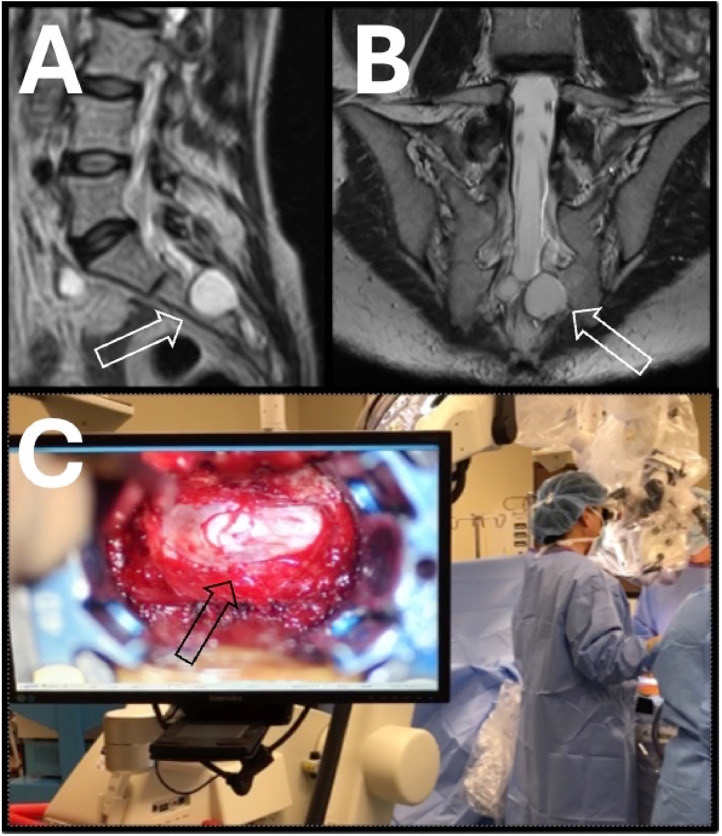
Sacral meningeal (Tarlov) cyst. (A, B) Sagittal and coronal T2-weighted MRI of a left S3 Tarlov cyst causing bony erosion (open arrows); images are best obtained orthogonal to the sacrum to show cyst shape, size and location. (C) Microscope view of the cyst at surgery, with increased vascular injection consistent with inflammation (black arrow). Most Tarlov cysts on imaging are asymptomatic. From Coorapati S, et al. N Am Spine Soc J. 2026;25:100866, Fig. 1 (CC BY 4.0).[6]
Psychiatric comorbidity is common but appears to follow the disorder more often than precede it. In the iPGAD study, 7 of 26 patients had a psychiatric diagnosis before PGAD onset and 18 after onset.[4] In a registry of 92 patients, almost 70% had psychiatric comorbidity, mostly depressive disorders, and most began after PGAD/GPD symptoms.[8]
The Controlled iPGAD Study
The iPGAD study compared 26 women meeting the Leiblum and Nathan criteria with 26 age- and education-matched controls. All participants had 3T MRI of the brain, pelvis and spinal canal from the conus to the sacrum, neurophysiology including pudendal somatosensory evoked potentials (SEP), and gynecologic examination with ultrasound.[4] The comparisons were exploratory and uncorrected for multiple testing.
| Finding | PGAD (n = 26) | Controls (n = 26) | p |
|---|---|---|---|
| Nerve root (Tarlov) cysts on MRI | 13 (50.0%) | 9 (34.6%) | 0.26 |
| Disc protrusion | 6 (23.1%) | 6 (23.1%) | 1.00 |
| Pelvic venous convolutions | 14 (53.8%) | 12 (46.2%) | 0.78 |
| Pelvic varices | 2 (7.7%) | 0 | 0.49 |
| Prolonged pudendal SEP latency (clinical reading) | 4 of 21 tested | 0 of 24 tested | Mean latencies and amplitudes not different |
| Restless legs symptoms | 8 (30.8%) | 0 | 0.004 |
| Urinary urgency | 19 (73.1%) | 1 (3.8%) | <0.001 |
| Urinary frequency | 12 (46.2%) | 3 (11.5%) | 0.013 |
| Spontaneous orgasms | 8 (30.8%) | 0 | 0.004 |
| Suicidality (any level) | 5 (19.2%) | 2 (7.7%) | 0.42 |
Data from Kümpers et al., 2023.[4]
The authors found no clear causal relationship between PGAD and any single clinical finding. They concluded that pelvic varices or pelvic congestion may be a cause in single cases but not a general etiologic factor. One study patient had already undergone coil embolization, which did not produce complete remission.[4] A sacral cyst or dilated pelvic vein on imaging does not by itself establish the cause. The surgical series below select patients by functional testing, such as a diagnostic injection, for this reason.[6][7]
Clinical Presentation
In the iPGAD study, symptoms were most often tingling or prickling and present continuously with slight fluctuation (13 of 26). Sites were the clitoris (80.8%), labia (50.0%), vaginal opening (46.2%), urethra (38.5%), mons pubis and pubic bone (19.2% each) and anus (15.4%). Radiation beyond the genitals was reported by 69.2%, most often to the legs and buttocks. Common triggers were tight clothing (42.3%), mental stress (38.5%), driving or riding in a car, bus or bicycle (38.5%), lying down (30.8%), and sitting upright, vibration and intercourse (26.9% each). Distraction (53.8%), relaxation (30.8%), exercise (26.9%), masturbation (23.1%) and swimming (23.1%) gave relief.[4] Spontaneous genital swelling (65.4% versus 3.8%) and increased lubrication (34.6% versus 7.7%) were more common than in controls.[4]
The 92-patient registry reported a similar picture: symptoms in the clitoris or glans penis in over 80%, extragenital symptoms in 50%, increased urinary urge in half, overactive bladder symptoms in more than 40%, and restless legs symptoms in about one third.[8] Sacral root series report perineal, bladder and bowel symptoms alongside PGAD.[12]
The ISSWSH consensus describes emotional lability, catastrophization and suicidal ideation.[1] In the iPGAD study, quality of life and sleep were worse than in controls, and anxiety, agoraphobia and lifetime panic disorder were more frequent; suicidality did not differ significantly from controls.[4]
Evaluation and Treatment: The Five-Region Process of Care
ISSWSH 2021 and ICSM 2024 recommend localizing the trigger to one or more of five regions and directing treatment to that region. Psychological and medical treatment run in parallel throughout.[1][3]
History. Character, location and radiation of symptoms; triggers and relieving factors; medication history, including the timing of SSRI, SNRI and anticonvulsant starts and stops; restless legs and overactive bladder symptoms; mental health and distress.[1][4]
Localizing tests. One multidisciplinary group (sexual medicine, urology, neurophysiology and spine surgery) uses the following tools:[6]
- Neurogenital testing. Quantitative sensory testing for warmth, cold and vibration, sacral dermatome testing, and bulbocavernosus reflex (BCR) latency. Abnormal results on all three suggest sacral radiculopathy. Abnormal sensory testing and BCR latency with normal sacral dermatomes suggest pudendal neuropathy. Abnormal sensory testing and dermatomes with normal BCR latency suggest a source above the conus medullaris.
- Regional anesthesia testing. Vestibular anesthesia testing for region 1 and pudendal nerve block for region 2.
- Imaging. Lumbosacral MRI; a sacral protocol with true axial, sagittal and coronal planes of the sacrum improves cyst visualization.
- Diagnostic epidural injection. For suspected region 3 disease, a caudal epidural injection of local anesthetic with steroid. A reduction of more than 50% in symptoms, or a Patient Global Impression of Improvement (PGI-I) score of 1 to 3, within the first 4 hours counts as positive. The same group uses targeted transforaminal epidural injections to confirm annular tear-related radiculopathy.[6][7]
| Region | Contributors described | Evaluation | Treatment options | Evidence |
|---|---|---|---|---|
| 1. End organ (clitoris, vulva, vestibule; glans penis) | Clitoral adhesions, associated with PGAD in a retrospective vulvoscopy cohort[18] | Genital examination with preputial retraction; vestibular anesthesia testing[6][18] | Treatment of identified local pathology (see Clitoral Phimosis) | Association in one retrospective cohort; no PGAD-specific treatment series |
| 2. Pelvis and perineum | Pudendal (dorsal branch) neuropathy; pelvic varices[4][11][15] | Pudendal SEP; diagnostic pudendal block; Doppler ultrasound and MRI or CT for pelvic venous incompetence[4][6][15] | Pelvic floor physical therapy, TENS, pudendal blocks, dorsal branch neurolysis, ovarian vein embolization, sacral neuromodulation[11][15][19][20][21] | Single case reports and one retrospective series of 8; controlled data show varices equally common in controls |
| 3. Cauda equina | Sacral meningeal (Tarlov) cysts; lumbosacral annular tears[7][12] | Neurogenital testing; sacral MRI; diagnostic caudal or transforaminal epidural injection[6][7] | Microsurgical cyst treatment (excision and imbrication); lumbar endoscopic spine surgery[6][7][12] | Case series of 11, 19 and 20 patients without controls; Tarlov cysts in 50% of iPGAD patients versus 35% of controls |
| 4. Spinal cord | Lesions above the conus medullaris[6] | Neurogenital pattern of abnormal sensory and dermatome testing with normal BCR latency; spinal MRI[6] | Treatment directed at the identified lesion and trigger location[3] | Consensus only |
| 5. Brain | Altered resting-state connectivity; epileptic foci, arteriovenous malformation and stroke have been proposed[4][5] | Brain MRI; EEG (no severe abnormality in an 18-patient series)[4][16] | Pharmacotherapy (see below); electroconvulsive therapy and transcranial magnetic stimulation reported[19] | Case-level reports; imaging findings preliminary |
Medical and Psychological Therapy
No randomized trial has been published. A scoping review of 38 studies in women found reported benefit from paroxetine, duloxetine, pramipexole, ropinirole and clonazepam. Physical approaches with reported effect included neuromodulation, TENS, botulinum toxin, surgery, electroconvulsive therapy, manual and pelvic floor therapy, dietary change and transcranial magnetic stimulation. Psychotherapy was effective only in combination with other treatment, and combination therapy was the usual successful strategy.[19] The review authors favored SSRIs, but the underlying data are case reports and small series.[19]
In the iPGAD study, 18 of 26 patients had tried medication; self-reported relief came with SNRIs in 5 of 8, gabapentin or pregabalin in 5 of 6, and SSRIs in 2 of 4.[4]
An integrative program of cognitive behavioral therapy, dialectical behavior therapy skills and mindfulness (3 assessment and 11 treatment sessions) was associated with less catastrophizing, anxiety and depression and fewer, shorter flares in a single case.[22]
Procedural and Surgical Options
| Procedure | Source | Design and patients | Outcome | Follow-up |
|---|---|---|---|---|
| Microsurgery for sacral meningeal cysts | Feigenbaum 2015[12] | Case series: 11 patients with PGAD within a cohort of 1,045 with symptomatic spinal meningeal cysts; all women; Tarlov cysts in 8 of 11; all had other sacral root symptoms | Self-reported: PGAD eliminated in 7 (64%), significantly improved in 3 (27%), unchanged in 1, none worse | Mean 23 months (2 months to 6 years) |
| Tarlov cyst excision and imbrication | Coorapati 2026[6] | Retrospective review of prospectively collected data, 2017 to 2023; 19 patients (68.4% women, 31.6% men); 17 of 18 injected had a positive diagnostic injection | PGI-I improved in 14 of 19 (73.7%), 11 much or very much better; 13 of 17 (76.5%) after a positive injection; 5 unchanged; none worse | Mean 18.2 ± 10.5 months |
| Lumbar endoscopic spine surgery for annular tear | Kim 2023[7] | 20 patients (15 women, 5 men), 22 procedures, 2016 to 2020; selected by stepwise algorithm with diagnostic transforaminal injection | PGI-I improved in 16 of 20 (80%); 13 of 20 (65%) much or very much better | Mean 20 months (12 to 37) |
| Neurolysis of the dorsal branch of the pudendal nerve | Klifto 2020[11] | Retrospective chart review, 2010 to 2018; 8 women | Bilateral surgery in 7: arousal symptoms eliminated in each; unilateral surgery in 1: partial improvement. Pain relief complete in 6 of 7 with pain | Mean 65 weeks (26 to 144) |
| Pudendal nerve block | Gyorfi 2024[20] | Single case: 55-year-old woman, 11 years of symptoms, refractory to medication, physical therapy and bilateral clitoral artery embolization | Bilateral blocks with triamcinolone and bupivacaine gave near-complete relief for 2 to 3 months, repeated serially; bilateral pudendal radiofrequency ablation gave minimal benefit | Ongoing serial blocks |
| Sacral neuromodulation | Jones 2016[21] | Single case: 32-year-old woman after failure of multiple treatments | Response to an implanted sacral neuromodulator with program settings the authors describe as unique | Not stated in abstract |
| Ovarian vein coil embolization | Thorne 2008[15] | Single case: 62-year-old woman with pelvic, vaginal wall, perineal and inguinal varices on Doppler and MRI | Marked reduction of symptoms after left ovarian vein embolization | Not stated in abstract |
Interpretation. Each surgical series is uncontrolled. The 2023 and 2026 spine series come from one multidisciplinary team that developed the selection algorithm and whose members also authored the ISSWSH and ICSM consensus statements. Outcomes are global impression or self-report; a PGAD/GPD-specific validated outcome measure was not available.[6][7] Neuromodulation and venous embolization rest on single case reports.[15][21] A 2025 review concluded that the relationship between Tarlov cysts and PGAD remains uncertain and that evidence for cyst treatment in PGAD is limited. It notes that neuromodulation is increasingly used as a rescue after failed decompression.[10]
Complications and Risks
- Tarlov cyst surgery. The 19-patient series reported same-day discharge and no cerebrospinal fluid leak, wound complication or cyst recurrence. The authors cite complication rates of 15% to 40% in earlier Tarlov cyst surgery series, which mostly treated larger cysts presenting with urinary dysfunction.[6] No surgical complications were reported after lumbar endoscopic spine surgery in 20 patients.[7]
- Dorsal branch neurolysis. No major surgical complications were observed in 8 women.[11]
- Sacral neuromodulation. Persistent genital arousal has been reported as a new symptom after implantation, persisting after device removal.[17] This is relevant when counseling any patient before sacral neuromodulation.
- Radiofrequency ablation. Pudendal radiofrequency ablation gave minimal benefit in the one reported PGAD case.[20]
Evidence Gaps
- A 2026 systematic review of studies from 2015 to 2025 included 14 studies and found no randomized trials. Diagnostic practice was inconsistent and follow-up and safety reporting were limited.[23]
- The first controlled clinical study is small (26 patients) and includes only women; its authors call for larger controlled samples.[4]
- In the 92-patient registry, most patients had no clear somatic correlate.[8]
- Surgical selection depends on diagnostic injections whose predictive value has not been tested against a nonoperative comparator. Most Tarlov cysts on imaging are asymptomatic.[6]
- Evidence on men is limited to inclusion in mixed surgical series, registries and survey data.[7][8][9]
See Also
- Chronic Pelvic Pain: pudendal neuralgia, small-fiber neuropathy and the multimodal pelvic pain framework
- Laparoscopic Pudendal Nerve Decompression
- Pelvic Venous Disorders: diagnosis and embolization of pelvic venous reflux
- Myofascial Pelvic Pain
- Sacral Neuromodulation and Pudendal Neuromodulation
- Clitoral Phimosis: clitoral adhesions as an end-organ finding
- Female Sexual Dysfunction: ISSWSH and DSM-5 classification of sexual dysfunction
References
1. Goldstein I, Komisaruk BR, Pukall CF, et al. "International Society for the Study of Women's Sexual Health (ISSWSH) review of epidemiology and pathophysiology, and a consensus nomenclature and process of care for the management of persistent genital arousal disorder/genito-pelvic dysesthesia (PGAD/GPD)." J Sex Med. 2021;18(4):665-697. doi:10.1016/j.jsxm.2021.01.172
2. Leiblum SR, Nathan SG. "Persistent sexual arousal syndrome: a newly discovered pattern of female sexuality." J Sex Marital Ther. 2001;27(4):365-380. doi:10.1080/009262301317081115
3. Goldstein I, Komisaruk BR, Goldstein SW, et al. "Persistent genital arousal disorder/genito-pelvic dysesthesia in all genders: recommendations from the Fifth International Consultation on Sexual Medicine (ICSM 2024)." Sex Med Rev. 2026;14(1):qeaf082. doi:10.1093/sxmrev/qeaf082
4. Kümpers FMLM, Sinke C, Schippert C, et al. "Clinical characterisation of women with persistent genital arousal disorder: the iPGAD-study." Sci Rep. 2023;13(1):22814. doi:10.1038/s41598-023-48790-2
5. Dalkeranidis E, Kümpers FMLM, Sinke C, Krüger THC. "Investigating brain activity at rest in patients with persistent genital arousal disorder (PGAD) using functional magnetic resonance imaging." Sci Rep. 2025;15(1):5063. doi:10.1038/s41598-024-82695-y
6. Coorapati S, Goldstein I, Goldstein SW, Komisaruk BR, Kim CW. "Tarlov cysts and sexual dysfunction: a multidisciplinary approach to evaluation and surgical treatment." N Am Spine Soc J. 2026;25:100866. doi:10.1016/j.xnsj.2026.100866
7. Kim CW, Goldstein I, Komisaruk BR, et al. "Lumbar endoscopic spine surgery for persistent genital arousal disorder/genitopelvic dysesthesia resulting from lumbosacral annular tear-induced sacral radiculopathy." J Sex Med. 2023;20(2):210-223. doi:10.1093/jsxmed/qdac017
8. Kümpers FMLM, Köhne S, Krüger THC. "Clinical characterization and management of persistent genital arousal disorder/genito-pelvic dysesthesia (PGAD/GPD): a registry study." Sex Med. 2026;14(1):qfaf106. doi:10.1093/sexmed/qfaf106
9. Jackowich RA, Pukall CF. "Prevalence of persistent genital arousal disorder in 2 North American samples." J Sex Med. 2020;17(12):2408-2416. doi:10.1016/j.jsxm.2020.09.004
10. Yosef R, Pron G, Lemos N, Murphy K. "Sacral Tarlov cysts and spontaneous persistent genital arousal: 2 unrecognized and underappreciated health conditions with an uncertain relationship." AJOG Glob Rep. 2025;5(4):100563. doi:10.1016/j.xagr.2025.100563
11. Klifto K, Dellon AL. "Persistent genital arousal disorder: treatment by neurolysis of dorsal branch of pudendal nerve." Microsurgery. 2020;40(2):160-166. doi:10.1002/micr.30464
12. Feigenbaum F, Boone K. "Persistent genital arousal disorder caused by spinal meningeal cysts in the sacrum: successful neurosurgical treatment." Obstet Gynecol. 2015;126(4):839-843. doi:10.1097/AOG.0000000000001060
13. Komisaruk BR, Lee HJ. "Prevalence of sacral spinal (Tarlov) cysts in persistent genital arousal disorder." J Sex Med. 2012;9(8):2047-2056. doi:10.1111/j.1743-6109.2012.02765.x
14. Oaklander AL, Sharma S, Kessler K, Price BH. "Persistent genital arousal disorder: a special sense neuropathy." Pain Rep. 2020;5(1):e801. doi:10.1097/PR9.0000000000000801
15. Thorne C, Stuckey B. "Pelvic congestion syndrome presenting as persistent genital arousal: a case report." J Sex Med. 2008;5(2):504-508. doi:10.1111/j.1743-6109.2007.00666.x
16. Waldinger MD, van Gils AP, Ottervanger HP, et al. "Persistent genital arousal disorder in 18 Dutch women: Part I. MRI, EEG, and transvaginal ultrasonography investigations." J Sex Med. 2009;6(2):474-481. doi:10.1111/j.1743-6109.2008.01113.x
17. Zoorob D, Deis AS, Lindsay K. "Refractory sexual arousal subsequent to sacral neuromodulation." Case Rep Obstet Gynecol. 2019;2019:7519164. doi:10.1155/2019/7519164
18. Aerts L, Rubin RS, Randazzo M, et al. "Retrospective study of the prevalence and risk factors of clitoral adhesions: women's health providers should routinely examine the glans clitoris." Sex Med. 2018;6(2):115-122. doi:10.1016/j.esxm.2018.01.003
19. Martín-Vivar M, Villena-Moya A, Mestre-Bach G, et al. "Treatments for persistent genital arousal disorder in women: a scoping review." J Sex Med. 2022;19(6):961-974. doi:10.1016/j.jsxm.2022.03.220
20. Gyorfi MJ, Abd-Elsayed A. "Pudendal nerve blockade for persistent genital arousal disorder (PGAD): a clinical review and case report." Pain Pract. 2024;24(6):852-855. doi:10.1111/papr.13362
21. Jones CL, Fischer JR, Hernandez SL. "Sacral neuromodulation for the treatment of persistent genital arousal disorder." Obstet Gynecol. 2016;128(2):321-323. doi:10.1097/AOG.0000000000001452
22. Merwin KE, Brotto LA. "Psychological treatment of persistent genital arousal disorder/genitopelvic dysesthesia using an integrative approach." Arch Sex Behav. 2023;52(5):2249-2260. doi:10.1007/s10508-023-02617-3
23. Bhowmik P, Shafiq MU, Sultan L, et al. "Persistent genital arousal disorder: a systematic review of diagnosis, etiology, and treatment approaches (2015-2025)." Urol Ann. 2026;18(2):95-105. doi:10.4103/ua.ua_157_25