Wound Healing
Wound healing is a highly coordinated biological process involving overlapping phases of cellular and molecular activity. Understanding these phases — and the factors that disrupt them — is fundamental to surgical planning, reconstructive timing, and complication avoidance. The process is classically divided into four phases: hemostasis, inflammation, proliferation, and remodeling.[1][2]

The four processes overlap. Their duration depends on the tissue, wound, perfusion, and clinical circumstances. WARWIKI schematic based on references 1 and 7.
Most of the phase descriptions below come from cutaneous wound healing. A mature skin scar generally remains weaker than uninjured skin; the often-quoted approximately 80% strength is a broad eventual estimate, not a day-60 milestone. Remodeling can continue for many months or longer. These observations do not establish catheter-removal, urethral-anastomosis, graft-loading, or reoperation schedules; use the specific repair and its clinical assessment.[1][7]
Phase 1: Hemostasis / Clot Formation
Begins immediately at time of injury
The first response to tissue injury is cessation of bleeding through a coordinated vascular and platelet response:[1][3]
- Vasoconstriction: A brief vascular response reduces local blood flow; platelet-derived mediators, including thromboxane A2, contribute
- Platelet activation: Platelets adhere to exposed subendothelial structures, including through von Willebrand factor (vWF), and release mediators that amplify platelet recruitment
- Platelet plug formation: Primary hemostasis — aggregated platelets form a loose mechanical plug
- Coagulation cascade: Fibrinogen is converted to fibrin (via thrombin), creating a fibrin mesh that reinforces the platelet plug and forms the provisional matrix — a scaffold for subsequent cellular migration
The fibrin clot provides weak initial wound tensile strength and serves as a reservoir of growth factors (PDGF, TGF-β, VEGF) released from platelet alpha-granules that initiate the subsequent inflammatory phase.
Phase 2: Inflammation
Starts early and overlaps with tissue rebuilding
Inflammation serves to clear debris and bacteria while recruiting the cells necessary for repair:[1][2]
- Vascular permeability and recruitment: Inflammatory mediators increase permeability; leukocytes adhere to and migrate across activated endothelium
- Neutrophils: Often prominent early, they phagocytose microbes and debris and release proteases and reactive oxygen species. Persistent or excessive activity can also injure tissue
- Macrophages: Resident cells and recruited monocyte-derived macrophages clear debris and dying neutrophils and coordinate inflammation, angiogenesis, and matrix formation through cytokines and growth factors
- Lymphocytes: Their contributions vary by cell subtype and wound context; they can regulate both inflammation and repair
- Transition toward repair: Resolution of inflammation and growth-factor signaling support proliferation. This is an overlapping shift in cell functions, not an abrupt switch at 48 or 72 hours
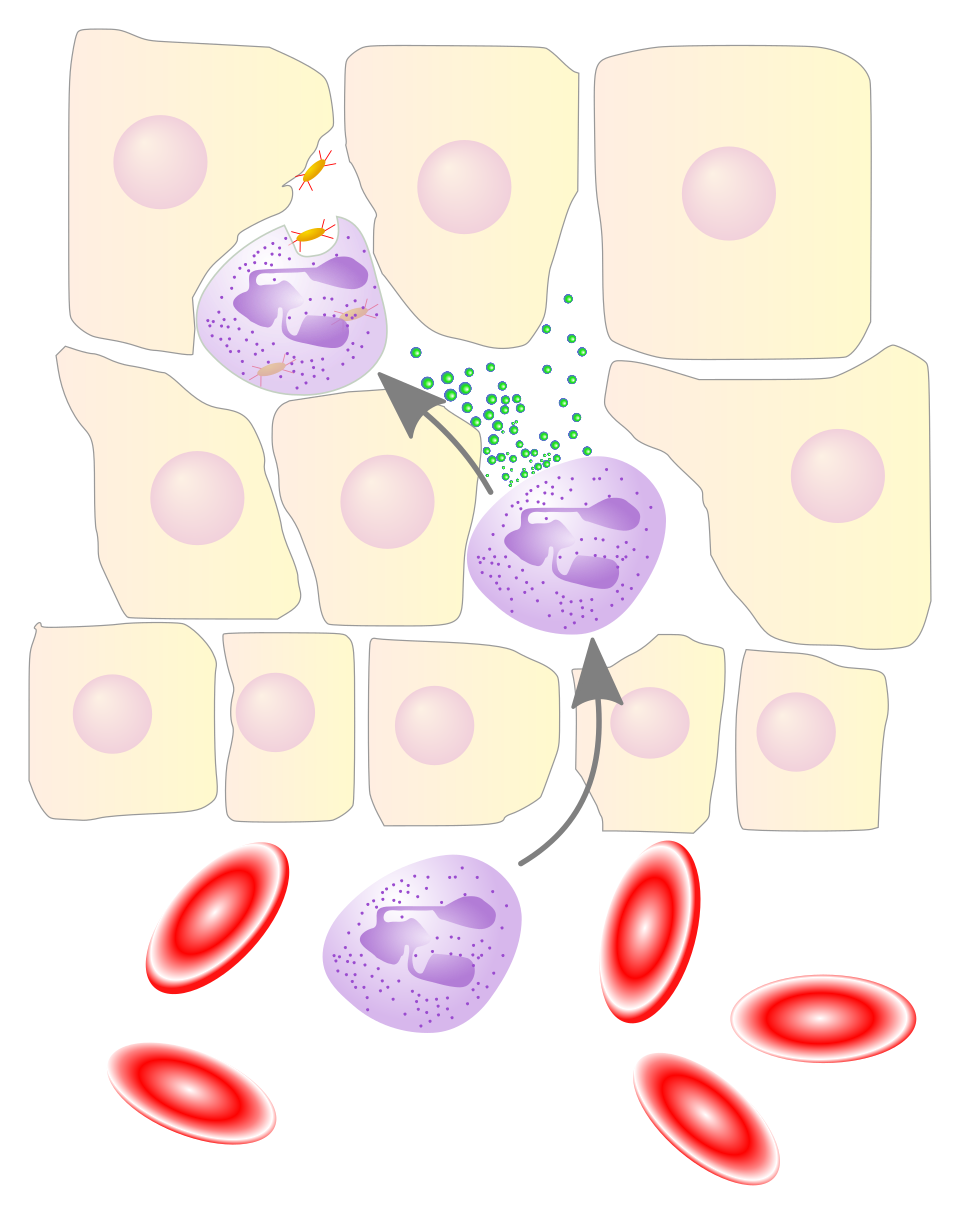
Schematic of neutrophil migration and bacterial phagocytosis; it does not define the timing of the entire immune response. Original by Mario Schubert, vector version by Mrmw, Wikimedia Commons source, CC0; rasterized here.
Classic guinea-pig macrophage-depletion experiments demonstrated delayed clearance, fibroblast activity, and collagen deposition. They support a coordinating role for macrophages; they do not establish that every wound is incapable of healing without a particular cell population.[1][4]
Phase 3: Proliferation
Develops over the early days and continues according to wound size and conditions
The proliferative phase rebuilds the wound matrix and restores structural integrity:[1][2]
- Fibroblast migration and proliferation: Stimulated by PDGF and TGF-β, fibroblasts migrate into the provisional fibrin matrix and begin synthesizing extracellular matrix. Fibroblasts are the dominant cell type of this phase
- Matrix formation: Fibroblasts produce glycosaminoglycans (hyaluronic acid, chondroitin sulfate) and proteoglycans that provide hydration and structural organization to the new matrix
- Collagen synthesis: Fibroblasts deposit an initially less organized collagen matrix containing types I and III. Its composition, alignment, and cross-linking change as the scar matures; type III is relatively more prominent early than in mature skin
- Wound contraction: Fibroblasts differentiate into myofibroblasts (under TGF-β influence), which contain smooth muscle actin and actively contract the wound margins. This reduces wound area but can lead to contracture deformity if excessive or in unfavorable locations
- Angiogenesis: Endothelial cells form new capillary networks in response to signals including VEGF; circulating progenitor cells may also contribute. These vessels help give granulation tissue its red appearance
- Epithelialization: Keratinocytes at wound margins and adnexal structures migrate across the wound surface under a moist environment
Protection during repair. Early wounds remain mechanically vulnerable while matrix accumulates and matures. Protect against excessive tension, shear, ischemia, and contamination. The duration and method of protection are procedure-specific, rather than derived from a skin-healing calendar.
Phase 4: Remodeling
Overlaps with matrix formation and can continue for many months or longer
Remodeling reorganizes and matures the collagen matrix, ultimately determining the quality and appearance of the final scar:[1][2]
- Matrix turnover: Collagen synthesis and degradation, including through matrix metalloproteinases (MMPs), continue as the scar matures
- Collagen composition: The relative contribution of type I collagen increases. Matrix organization and cross-linking, as well as composition, determine mechanical strength
- Collagen reorganization: Collagen fibrils align along lines of mechanical stress and form stronger intermolecular cross-links via lysyl oxidase
- Reduced cellularity and vascularity: Many repair cells and newly formed vessels regress, making mature scars less cellular and often paler; a scar is not necessarily avascular
- Mechanical maturation: Strength increases over time but generally does not return to that of uninjured skin. There is no universal percentage-by-day schedule applicable to all tissues or repairs
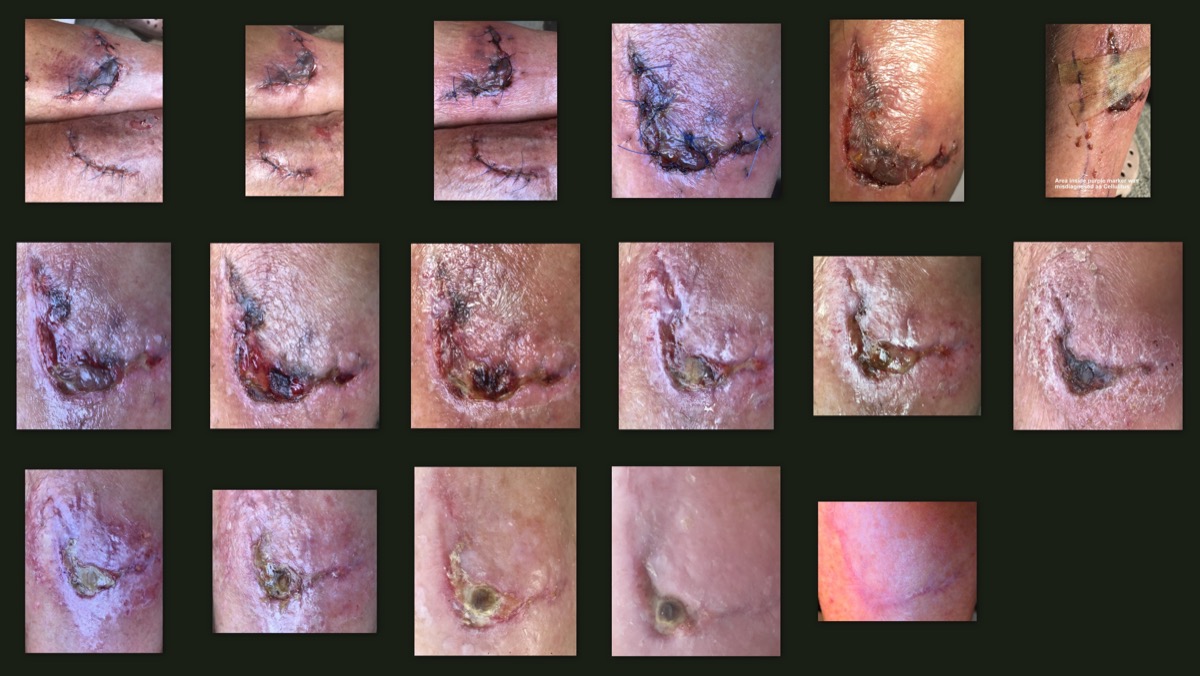
One sutured hiking injury photographed over five weeks, not a prescribed healing timetable. Photographs by Raquel Baranow, montage edited by LightNightLights; original image, CC BY-SA 4.0. Resized for this site.
Chronic wounds. Persistent inflammation and abnormal matrix turnover can accompany poor healing. Look for impaired perfusion, infection, pressure or repetitive trauma, foreign material, and systemic contributors. Management addresses the cause through perfusion assessment, appropriate debridement and infection treatment, protection or offloading, and nutritional support when indicated; routine pharmacologic MMP suppression is not an established general pathway.[7] An atypical or persistently nonhealing wound, particularly after radiation, also warrants assessment for malignancy.[6]
Systemic Factors Affecting Wound Healing
| Factor | Mechanism of Impairment |
|---|---|
| Age | Cellular responses can be slower; comorbidity and frailty also matter. Older age alone does not imply inevitable healing failure[7] |
| Smoking | Tobacco smoke impairs oxygen delivery, immune function, and repair. Clinical evidence associates smoking with wound complications; perioperative cessation trials show fewer surgical-site infections, without establishing the same reduction for every healing endpoint[5] |
| Diabetes mellitus | Impaired leukocyte function, reduced angiogenesis (decreased VEGF response), neuropathy, microvascular disease, elevated glucose impairs fibroblast proliferation |
| Malnutrition | Inadequate energy/protein or micronutrient deficiency can impair repair. Vitamin C supports proline/lysine hydroxylation; vitamin A supports epithelial and immune functions. This does not justify routine high-dose supplementation. Low albumin signals risk and inflammation but is not a stand-alone nutritional diagnosis; see Perioperative Nutrition[7] |
| Corticosteroids | Effects depend on dose, duration, and indication; chronic exposure differs from a single perioperative dose. Use the perioperative steroid workflow for clinical decisions |
| Immunosuppression | Effects vary by drug, regimen, and underlying disease. Balance infection and repair concerns against rejection or disease flare; avoid blanket withdrawal rules |
| Radiation | Can cause persistent microvascular injury, fibrosis, and altered fibroblast function. Injury varies with dose, field, tissue, and time; not every irradiated bed is uniformly or permanently hypoxic[6] |
Local Wound Factors
Assess local and systemic contributors together; their relative importance depends on the wound:[7]
| Factor | Effect |
|---|---|
| Infection | Prolongs inflammation and can increase protease-mediated matrix damage, impairing repair |
| Ischemia / Oxygen delivery | Microvascular disease → reduced tissue perfusion; hypoxia impairs fibroblast function, collagen synthesis, and leukocyte bactericidal activity |
| Radiation | Fibrosis and vascular/cellular injury may impair healing; assess tissue quality and perfusion rather than assuming a uniform effect |
| Moisture / Temperature | Avoid desiccation and maintain appropriate thermal conditions; excessive moisture and maceration can also damage the wound edge |
| Wound tension | Excessive tension at wound edges impairs perfusion and increases dehiscence risk; a fundamental principle of plastic surgery is closure without tension |
| Foreign body / Suture material | Perpetuates inflammation; prolongs inflammatory phase; increases infection risk |
Video Resource
For a visual overview of the wound healing cascade:
Wound Healing — Mechanism and Phases (YouTube)
References
1. Diegelmann RF, Evans MC. Wound healing: An overview of acute, fibrotic and delayed healing. Front Biosci. 2004;9:283–289. PMID 14766366
2. Gurtner GC, Werner S, Barrandon Y, Longaker MT. Wound repair and regeneration. Nature. 2008;453(7193):314–321. PMID 18480812
3. Singer AJ, Clark RAF. Cutaneous wound healing. N Engl J Med. 1999;341(10):738–746. PMID 10471461
4. Leibovich SJ, Ross R. The role of the macrophage in wound repair: A study with hydrocortisone and antimacrophage serum. Am J Pathol. 1975;78(1):71–100. PMID 1109560
5. Sørensen LT. Wound healing and infection in surgery: The clinical impact of smoking and smoking cessation: A systematic review and meta-analysis. Arch Surg. 2012;147(4):373–383. DOI: 10.1001/archsurg.2012.5 · PMID 22508785
6. Dormand EL, Banwell PE, Goodacre TEE. Radiotherapy and wound healing. Int Wound J. 2005;2(2):112–127. PMID 16722862
7. Guo S, DiPietro LA. Factors affecting wound healing. J Dent Res. 2010;89(3):219–229. DOI: 10.1177/0022034509359125 · Full text