Allis Clamp
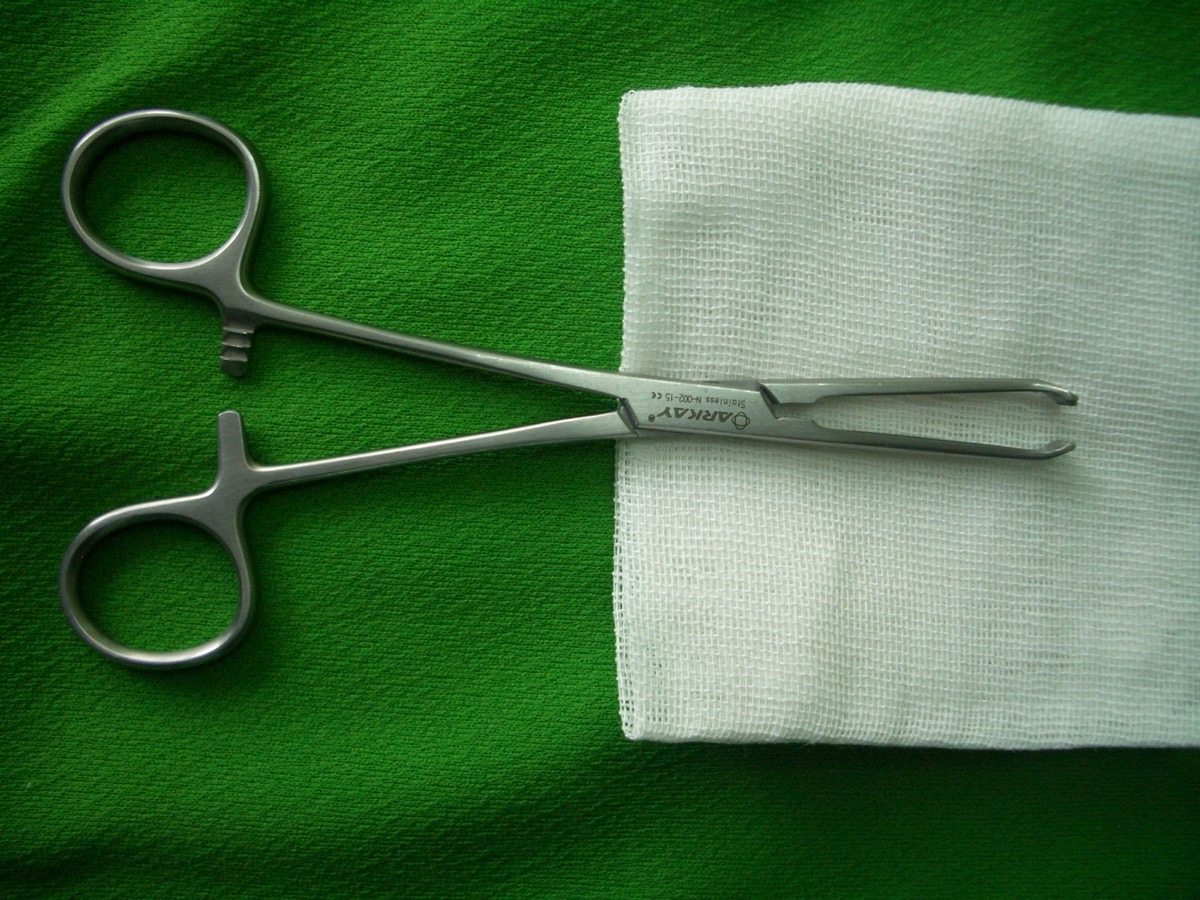
Allis clamp with toothed tips. (Image: Wikimedia Commons, public domain.)
An Allis clamp is a ring-handled, ratcheted tissue forceps with several interlocking teeth at its tips. It provides purchase on selected tissue edges, including fascia, skin, vaginal tissue and specimens. Straight and angled patterns, lengths and tooth counts vary by model.[1]
Toothed purchase can injure viable tissue. Allis is neither a universal “hold-everything” clamp nor restricted to tissue being discarded: tissue quality, the grasp site, pressure, traction and the intended reconstruction determine whether it is suitable.
Recognition and selection
| Feature | What it means |
|---|---|
| Several interlocking tip teeth | Distinguishes the common Allis pattern from the single 1×2 tip arrangement of a Kocher. |
| Ratchet | Maintains jaw closure; it does not measure tissue pressure. |
| Different tooth counts and lengths | Choose for access and the tissue bite. More teeth do not establish a predictable grip or injury advantage. |
| Example specifications | Sklar lists a straight 6-inch 3×4-tooth model and a delicate 5-inch 4×5-tooth model. These are examples, not universal dimensions.[1][2] |
In reconstruction, selected fascial edges, vaginal tissue and tissue planned for excision may tolerate a toothed grasp. Protect the part of a graft or flap that must remain perfused or form the repair. Direct clamping of delicate ureteral, bowel, vascular or microsurgical tissue requires a more suitable handling strategy; a different instrument's “atraumatic” label still does not guarantee safety.
Cervical stabilization evidence
A small randomized study of 95 IUD insertions reported bleeding after removal in 6.3% with Allis versus 55.3% with a single-tooth tenaculum. Insertion success, pain scores and the number of hemostatic interventions did not differ. This supports Allis as an option for that specific task; it does not establish less injury or superior outcomes in vaginal-flap surgery, fistula repair or other reconstruction.[3]
Handling
- Inspect tip alignment, the joint and ratchet before use. Remove a damaged instrument from service.
- Select the smallest effective tissue bite and traction needed for exposure; reassess if tissue slips, blanches or tears.
- Avoid preset “first or second ratchet is safe” rules. Jaw pressure depends on the instrument and tissue, not the notch number alone.
- Release and reposition when the task permits. Avoid repetitive grasping of a planned anastomotic or graft edge.
- Reprocess the exact instrument according to its instructions; reusable and disposable versions are not interchangeable care categories.
See also: Babcock, Kocher, DeBakey forceps.
References
1. Sklar. Allis tissue forceps, 6 inches, 3×4 teeth, model 36-2060. Manufacturer description and specifications.
2. Sklar. Delicate Allis tissue forceps, 5 inches, 4×5 teeth, model 18-2155. Manufacturer specifications.
3. Andrews B, Quick K, MacLeod E, Edwards K, Rone BK. Cervical bleeding with cervical stabilization during IUD placement: Allis clamp versus single-tooth tenaculum, a randomized control trial. Arch Gynecol Obstet. 2023;307(4):1015–1019. doi:10.1007/s00404-022-06784-x.