Babcock Clamp
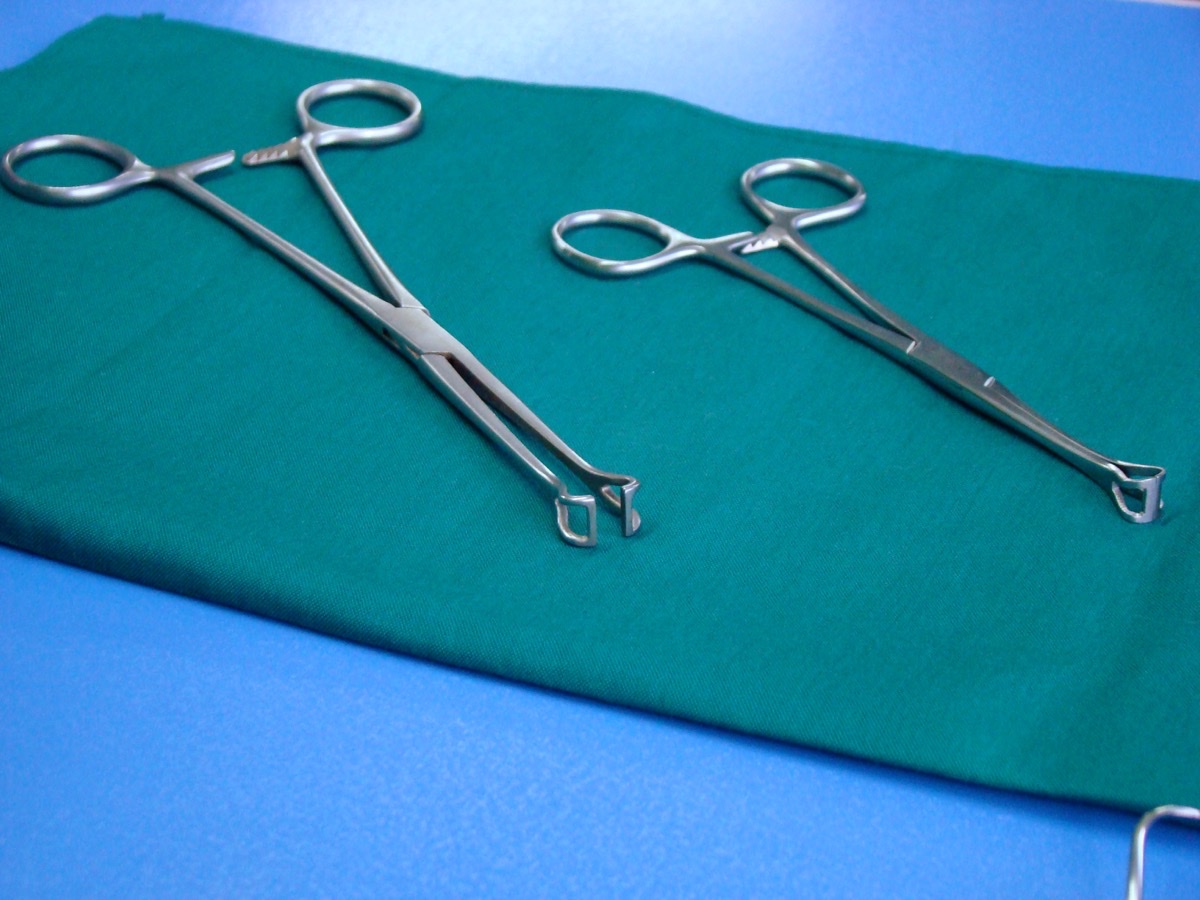
Babcock forceps with broad, fenestrated jaws. The design does not eliminate compression injury. (Image: Wikimedia Commons, public domain.)
A Babcock forceps is a ratcheted, ring-handled tissue clamp with rounded, fenestrated jaws, commonly used for selected bowel and tubular-tissue handling. It lacks the projecting interlocking tip teeth of an Allis or Kocher. Toothless does not mean smooth: the Sklar 36-1662 pattern has horizontal serrations on its grasping surface.[1]
What the design does
The broad contact surface is intended to distribute the grasp over more tissue than a sharp tip. “Atraumatic” or “non-crushing” describes the intended handling pattern, not immunity from ischemia, perforation or tearing. Closing the jaws still loads the tissue; the window does not create a pressure-free enclosure.
| Feature | Practical implication |
|---|---|
| Fenestrated jaws | Useful for selected tubular or soft-tissue handling; inspect what is actually caught between the surfaces. |
| Ratchet | Holds closure without continuous hand pressure. No notch guarantees an injury-free force. |
| Model variation | Length, jaw dimensions and surface finish differ. A standard Sklar example is 6¼ inches; inspect the actual instrument.[1] |
| Delicate or compromised tissue | Reduce direct grasping and traction; choose another exposure method when safe purchase cannot be maintained. |
Reconstructive use
Babcock forceps can help handle a selected bowel segment or appendix during diversion, augmentation or channel construction. The intended viable wall and blood supply must be protected throughout the maneuver. The device name alone does not justify routinely locking a clamp across a ureter, vas, vascular pedicle or thin repair edge.
If the tissue slips, reassess exposure, the bite and the instrument. Increasing compression or automatically changing to a toothed clamp can trade slipping for tissue injury. Avoid pulling against fixed resistance and repeated grasping at one fragile point.
Laparoscopic and robotic graspers have their own jaw geometries, closing forces and instructions. A fenestrated appearance, including a robotic ProGrasp design, does not make them interchangeable with an open Babcock.
Handling and care
Inspect the jaws, alignment, box lock and ratchet. Use only the closure and traction required for the task, release when feasible, and check the tissue after the grasp. Follow the model's cleaning and sterilization instructions; a reusable instrument supplied nonsterile needs validated processing before use.[1]
See also: Allis, Kocher, Singley forceps, DeBakey forceps.
References
1. Sklar. Babcock forceps, 6¼ inches, model 36-1662. Manufacturer description and specifications.