Kocher Clamp
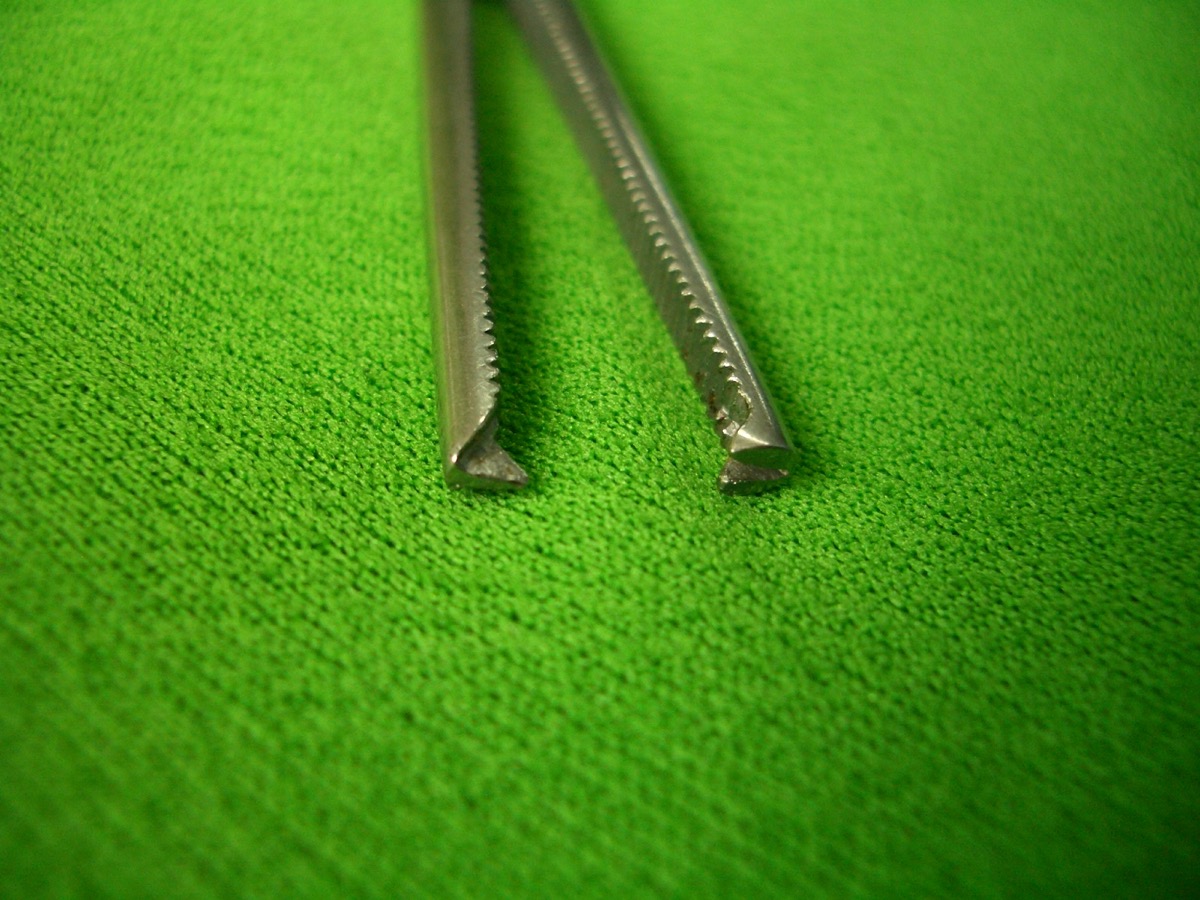
Kocher jaw detail: serrations and an interlocking tip tooth. (Image: Wikimedia Commons, public domain.)
The common Kocher tissue/hemostatic clamp has ring handles, a ratchet, serrated jaws and 1×2 interlocking teeth at the tip. It provides firm purchase on selected tough tissue. The tooth can penetrate and the jaws can crush; this is not a clamp for preserving delicate vessel, bowel or ureteral walls.[1][2]
Identify the pattern
Kocher, Ochsner and Rochester-Ochsner names overlap in instrument catalogs, but size, weight and jaw pattern vary. Check the complete product name. A separate Kocher intestinal pattern or a laparoscopic instrument should not be assumed to have the same jaws as the open toothed clamp described here.
| Feature | What to inspect |
|---|---|
| Tip teeth | The single tooth fits between two opposing teeth; verify alignment and integrity. |
| Serrated jaws | Standard examples have transverse serrations along the jaw, unlike a merely toothed tip. |
| Straight or curved shaft/jaws | Select for the access and intended tissue bite. |
| Ratchet and joint | Confirm engagement and release; a fixed notch number does not specify a safe tissue pressure. |
Sklar's Rochester-Ochsner 17-2862 is a straight 6¼-inch example. Longer Kocher models and more delicate patterns exist; the name does not establish that every version is heavier or stronger than every other clamp.[1][2]
Reconstructive use and limits
- Fascial traction: selected robust edges may tolerate a toothed grasp. Preserve tissue needed for closure; the use of Kocher on fascia does not imply the fascia must be discarded.
- Specimens or tissue planned for excision: firm purchase may be useful, provided adjacent viable structures are protected.
- Pedicle work: choose a clamp and ligation method appropriate to the identified structure. Do not use a generic tissue-clamp description as a vascular-control protocol.
- Reoperative or irradiated tissue: fibrosis does not prove tissue strength. Avoid using forceful clamp traction to create an unconfirmed plane.
Use a tissue-preserving strategy for anastomotic edges, grafts and fragile viscera. An Allis is also toothed, and a Babcock can still compress; switching names alone does not make a grasp safe. Remove the clamp as the operative step permits and assess the tissue before proceeding.
Choose by the actual jaw geometry and task rather than an unsupported universal “strongest-to-gentlest” ranking.
See also: Allis, Babcock, DeBakey forceps.
References
1. Sklar. Rochester-Ochsner forceps, 6¼ inches, straight, serrated, 1×2 teeth, model 17-2862. Manufacturer description and specifications.
2. Sklar. Kocher forceps, curved, 20 inches, model 61-2103. Manufacturer description and specifications.