Gelpi Retractor
The Gelpi is a self-retaining retractor with a single curved, sharp prong on each arm and a locking handle. It provides two opposing retraction directions in a relatively compact instrument without a table-mounted frame. The single-point tips distinguish it from the multiprong Weitlaner.[1][2]
Design and sizes
- Single sharp tips engage the selected tissues at two points.
- Handle lock maintains the selected spread after placement.
- Different lengths and blade patterns suit different access depths; a long or deep Gelpi variant is not interchangeable with the smallest pattern.
- Ball-stop versions are available alongside standard patterns.
Teleflex lists examples from 9 cm to 18.5 cm, including the 18 cm ball-stop model KM52769 and the standard Pilling 165440. Other Gelpi-family instruments, such as the deeper Wiltse-Gelpi, have different geometry. Use the exact catalog number when requesting the instrument.[1][2]
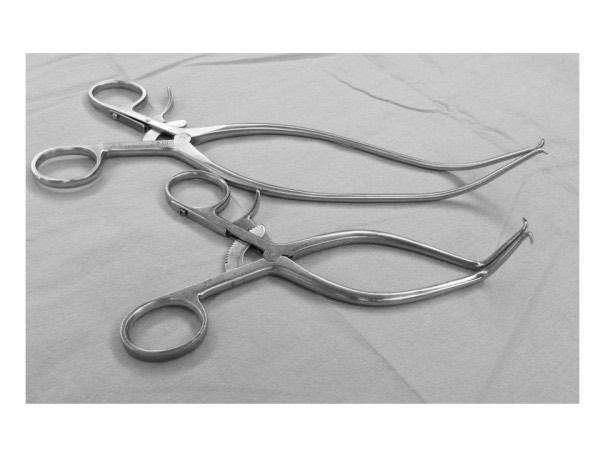
Two Gelpi retractors: self-retaining instruments with two arms hinged at the middle, each ending in a single curved, pointed tip, with a locking handle. From Pang L, et al. Scoliosis. 2014;9:17, Figure 1 (CC BY 4.0).[5]
Practical role in reconstructive surgery
The Gelpi gives local two-sided exposure in small or superficial-to-moderate-depth wounds where fascia or muscle can hold the tips. Typical settings, based on operative practice rather than manufacturer claims, include:
- Scrotal and inguinal wounds: prosthesis pump-pouch or reservoir exposure, hydrocelectomy, vasovasostomy and spermatic cord access.
- Perineal incisions: an adjunct to a Turner-Warwick or perineal Bookwalter for skin and superficial fascia at perineal urethrostomy, bulbar exposure and male sling work.
- Muscle-harvest incisions: paired Gelpis along a medial thigh incision for gracilis harvest.
- Recipient-vessel exposure: femoral, inferior epigastric or saphenous access in free-flap genital reconstruction.
Choose by tissue. In loose subcutaneous tissue, scrotal skin or vulva, single tips tend to slip or tear. A multiprong Weitlaner or carefully placed skin hooks may work better there. Near named nerves such as the dorsal penile, pudendal, ilioinguinal or genitofemoral branches, prefer a blunt multiprong instrument. For several directions of soft-tissue traction, a Lone Star offers independently positioned elastic stays. On a long incision, two Gelpis in series give staggered exposure.
Placement and handling
- Check the tips and lock before use; identify any ball stops and confirm the available opening.
- Place both tips under direct vision in tissue capable of holding the intended traction. Keep the points clear of vessels, nerves and other structures at risk.
- Increase spread gradually until the exposure is adequate.
- Watch for tearing, slipping or excessive tension. If purchase is poor, reposition or choose a different retractor rather than opening further.
- Reassess during the operation, particularly when the target or tissue layer changes. Release the lock under control before repositioning or withdrawal.
These are general surgical handling principles. Tissue purchase, opening width and release timing depend on the incision and tissue condition; none guarantees safety in every incision.
Gelpi and Weitlaner: useful distinctions
| Feature | Gelpi | Weitlaner |
|---|---|---|
| Tissue contact | One point per arm | Several prongs per blade |
| Exposure pattern | Two opposing points | Two opposing multiprong blades |
| Variants | Different lengths, depths and stop configurations | Different lengths and sharp/blunt prong configurations |
| Selection question | Can each tip obtain controlled purchase without injuring adjacent structures? | Does the blade fit the field, with appropriate contact at all prongs? |
A multiprong or blunt instrument can still cause pressure injury.
Prolonged retraction
Sharp tips can puncture or tear tissue, and traditional self-retaining retractors with sharp tips are recognized as capable of damaging tissue.[4] In one posterior scoliosis case report, a Gelpi tip appeared to penetrate the pleura, causing a massive postoperative hemothorax; this is a spinal-surgery safety signal, not an estimated risk in reconstructive urology.[5] Prolonged traction can also impair perfusion. In 20 patients having two-level lumbar laminectomy, deep paraspinal muscle retraction (Norfolk and Norwich or McCulloch retractors, not a Gelpi) raised intramuscular pressure so that estimated perfusion pressure approached 0 mm Hg. Retraction longer than 60 minutes was associated with worse back pain and disability scores at 6 months. The authors suggested periodic relaxation to allow perfusion.[3] This is spinal surgery evidence. Periodic release is a reasonable principle in long perineal or gracilis-harvest cases, but the 60-minute figure has not been validated there.
Care
Confirm the reusable instrument's supplied cleaning and sterilization instructions. Protect the sharp points during transport, inspect them for damage and clean the locking joint before reuse. The Teleflex IFU portal can be searched using the instrument's product code.
See also: Skin hooks, Senn, Volkmann, Turner-Warwick.
References
1. Teleflex. Gelpi retractors: ordering information and prong configurations. Manufacturer catalog, accessed September 20, 2026.
2. Teleflex / Pilling. Orthopedic self-retaining retractor catalog. Gelpi-family sizes and variants.
3. Datta G, Gnanalingham KK, Peterson D, et al. Back pain and disability after lumbar laminectomy: is there a relationship to muscle retraction? Neurosurgery. 2004;54:1413–1420. doi:10.1227/01.NEU.0000124751.57121.A6. Adjacent-specialty clinical context.
4. Pearl CB, Aguillon A, McLaughlin E, Yu J. Inexpensive self-retaining retractor for minor surgical procedures. Ann Plast Surg. 2003;51:633–635. doi:10.1097/01.SAP.0000096148.73798.06.
5. Pang L, Watanabe K, Toyama Y, Matsumoto M. Massive hemothorax caused by Gelpi retractor during posterior correction surgery for adolescent idiopathic scoliosis: a case report. Scoliosis. 2014;9:17. doi:10.1186/1748-7161-9-17.