Urethrolysis
Urethrolysis is a salvage operation that relieves iatrogenic bladder outlet obstruction (BOO) after anti-incontinence surgery. The causes are an overly tensioned midurethral sling (the most common), hypersuspension after retropubic bladder neck suspension, postoperative periurethral scar, and obstructing mesh.[1] The literature reports obstruction after 2.5–24% of anti-incontinence procedures, with 50–75% of those patients receiving surgical correction.[1]
The term "urethrolysis" historically covers a spectrum from simple sling transection to complete circumferential urethral mobilization. A 2025 review proposes reserving "urethrolysis" for extensive periurethral dissection and using "sling incision" or "sling excision" for the limited transvaginal procedures used after MUS. Most obstruction today follows a synthetic midurethral sling and can be treated with simple sling incision.[1]
Indications and Diagnosis
The only absolute selection criterion in Carr and Webster's series was a clear temporal relationship between symptoms and the prior anti-incontinence procedure.[2] Presenting symptoms include urinary retention, hesitancy, slow or interrupted stream, incomplete emptying, urgency or frequency, recurrent UTI and de novo urge incontinence. A low PVR does not exclude obstruction.[1][2]
| Workup element | Finding suggestive of BOO |
|---|---|
| History and exam | Symptom onset temporally linked to prior sling / suspension; urethral tenderness; positive Q-tip deflection |
| Noninvasive uroflow | Slow or interrupted stream |
| Post-void residual | Elevated PVR |
| Multichannel UDS with pressure-flow | Low flow with high detrusor pressure. Female UDS lacks precision and should not alone rule out obstruction. Low pressure with low flow occurs with long-standing obstruction and detrusor underactivity[1] |
| Urinalysis and culture | Obtain urinalysis; if findings suggest UTI, obtain a culture, treat as appropriate, and reassess symptoms[1] |
| Cystoscopy | Mesh erosion; urethral angulation or kinking[3] |
ACOG Committee Opinion 694 (2017) states that short-term voiding dysfunction after a synthetic midurethral sling, if improving, can be managed expectantly for up to 6 weeks. Retention, or small-volume voids with a large PVR, warrants earlier intervention.[3] Gleich and Goldman advise that surgeons uncomfortable treating obstruction should refer to a specialist.[1]
Obstruction can also present long after a sling that was not obstructive when placed. Based on anecdotal experience removing obstructive slings, progression of anterior or apical pelvic organ prolapse has been associated with a previously nonobstructive sling becoming obstructive 10 or more years after placement. This is a possible delayed-onset diagnostic consideration from one chapter's authors' experience, not an established causal association or a frequency estimate.[19]
Surgical Approaches
The approach is primarily driven by the type of original anti-incontinence procedure. Review the index operative report and any prior release or excision reports to identify the implant, its route, permanent sutures and previous dissection.[1]
| Approach | Best for | Success rate | Notes |
|---|---|---|---|
| Simple sling incision | Sling obstruction (including MUS; first-line) | 70–90% significant improvement in obstructive voiding symptoms[5] | Transvaginal midline transection of the sling; ~20% recurrent SUI |
| Transvaginal urethrolysis | Post-retropubic suspension or failed sling incision | 29/41 (71%) voided normally after urethrolysis plus Raz resuspension (mean 21 months)[10]; 73% of 15 vaginal procedures had complete or significant symptom improvement (median 10 months)[2]; 33/39 (85%) had urge-incontinence resolution, although five women in that cohort still required occasional intermittent catheterization (mean 16 months)[6] | Periurethral fascia dissection, endopelvic fascia perforation, sharp scar / suture release |
| Retropubic (open) urethrolysis | Prior retropubic surgery, hostile vaginal field | Obstructive or overactive symptom relief in 7/9 (78%) post-Burch cases (average follow-up 7 months)[1][23]; complete or significant symptom improvement in 86% of 35 retropubic procedures (median follow-up 10 months)[2] | Lower midline / Pfannenstiel; urethral mobilization from inferior pubis |
| Suprameatal transvaginal urethrolysis | Obstruction after prior anti-incontinence surgery (12 pubovaginal slings, 19 suspension procedures, one anterior repair) | 13/20 (65%) women in retention voided well; urgency symptoms resolved in 8/12 (67%) women with urgency[4] | Dissection above the meatus without lateral perforation of the urethropelvic ligament; preserves lateral attachments |
| Laparoscopic / robotic urethrolysis | After retropubic bladder neck suspension; improved deep-pelvic visualization | Small series and technique videos (robotic: 5 of 6 with complete symptom resolution)[7][8] | Useful when prior retropubic anatomy demands MIS access. Gleich and Goldman prefer a robotic transabdominal approach for post-suspension obstruction |
Key Surgical Considerations
- Martius fat-pad interposition between the urethra and pubis may reduce recurrent scar formation. Gleich and Goldman consider it for repeat urethrolysis, heavy scarring or concomitant urethrotomy, and describe its value as limited in their experience.[1][2][9]
- No concomitant resuspension. Gleich and Goldman do not place a new sling or resuspension at the time of urethrolysis or sling incision, because some patients remain continent and a persistent problem would be unclear afterward (author opinion).[1]
- Intraoperative cystourethroscopy at completion to confirm no urethral or bladder injury.[1]
- No urethrolysis-specific VTE recommendation exists; apply the general reconstructive-pelvic-surgery risk framework (age, obesity, prior VTE, malignancy, prolonged operation or immobility) on the VTE Prophylaxis page.
Operative Technique by Approach
1. Simple Sling Incision (Transvaginal)
First-line for midurethral sling obstruction, with the least extensive dissection.[1][5] In the first 7–10 days after a synthetic sling, the vaginal incision can be reopened and the sling gently pulled down ("loosening"). In a retrospective series of 33 consecutive women who had early mobilization of a tension-free vaginal tape for postoperative voiding dysfunction, performed under general anesthesia within 2 weeks of the original procedure without dividing the tape, voiding returned to normal in 29 of 33 with no recurrence of stress incontinence; the remaining 4 had the tape divided.[13] A separate description of the same maneuver frames it as an acute technique best performed before day 14, loosening the tape by about 1–2 cm with a right-angle or other small clamp; after tissue ingrowth, cutting the tape may be preferable to loosening. It can be done in the office under local anesthesia in a cooperative patient, or in the operating room with light IV sedation and local anesthesia. Reconcile this author-described timing and technique with the case series above; neither establishes an optimal amount of loosening.[14]
- Small midline transvaginal incision over the sling.
- Light horizontal scalpel movement along the anterior surface of the dissection confirms sling location and exposes mesh fibers. Avoid going deep; urethral injury is a risk.
- If the sling is hard to locate: extend the incision, palpate the anterior vaginal wall between the bladder neck and meatus, or insert a cystoscope sheath into the urethra to facilitate palpation.
- Once identified, place a right-angle clamp between the sling and suburethral tissue. Spread the tips carefully, then transect sharply. Identifying and taking 360-degree control of the taut sling before sectioning it has been emphasized as a safety step; dividing it without that control risks injury to or misidentification of adjacent structures.[15]
- The two sling portions retract laterally once tension is released. This recoil has been described as a practical sign that release has occurred, which may mean formal urethrolysis is not needed.[15]
- If additional release is needed: grasp the cut edge with an Allis, dissect laterally with Metzenbaum scissors (or blunt with a peanut sponge if the sling separates easily) to the lateral sulcus or endopelvic fascia, then cut each arm free with curved Mayo scissors.
- Close vaginal incision with absorbable suture. Patients often report immediate improvement in voiding and stream force.[1]
- If obstructive symptoms persist after sling incision, part of the sling may remain intact, since dense scar can hide it at the first operation. Gleich and Goldman report that operative reports in such patients often describe difficulty identifying the sling.[1]
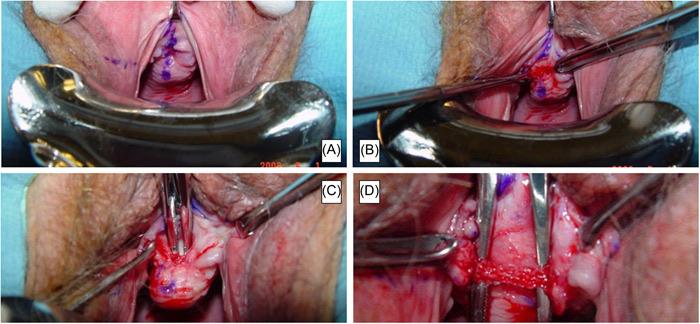
Transvaginal synthetic sling incision. (A) Anterior vaginal wall marked. (B) Incision with the edge of the mesh exposed. (C) Right-angle instrument passed behind the mesh. (D) Synthetic mesh sling fully exposed and ready to be cut. From Gleich LD, Goldman HB. Neurourol Urodyn. 2025;44(1):76-84, Figure 3 (CC BY-NC).[1]
Fascial slings. The suburethral portion must be addressed transvaginally. Within approximately 2 weeks of the original surgery, the sling ends scar in retropubically, so releasing retropubic sutures alone will not adequately relieve tension.[1] Early loosening of an autologous fascial sling, usually within 6 weeks of surgery, by applying caudal pressure to the urethra with a cystoscope under anesthesia, has been described as successful in one chapter's author experience, with a caution that periurethral fibrosis may worsen urethral rigidity; those authors' opinion is that during the first 3–6 months after sling surgery a single sling incision will likely be adequate instead of formal urethrolysis. Neither statement carries a reported case count or maneuver-specific outcome rate and both differ from the first-2-weeks mobilization of a synthetic tape above.[16]
For persistent voiding dysfunction requiring takedown of an autologous pubovaginal sling, whether vaginal urethrolysis or sling takedown is performed depends on whether the fascial sling can be identified and isolated from the urethra. When the sling is cut, sewing an interposing segment of biologic tissue (for example cadaveric fascia lata) between its cut ends has been described as a way to reduce the chance of recurrent SUI after takedown; no denominator, follow-up, or comparative recurrence estimate supports this as a validated benefit.[17]
2. Formal Transvaginal Urethrolysis
Appropriate after retropubic bladder neck suspension or when sling incision has failed.[1]
- Positioning: dorsal lithotomy with Trendelenburg; Foley placed; bladder neck identified.
- Incision: vertical midline or inverted-U incision along the anterior vaginal wall between midurethra and bladder neck.
- Periurethral dissection bilaterally until the endopelvic fascia is encountered, then perforated with heavy Mayo scissors.
- Scar and suture removal. Sharp incision of scar tissue and sutures. Imperative to remove all permanent sutures. If a suture is difficult to expose on the inferior pubis, place a right-angle clamp under finger guidance, insinuate between the suture and pubis, and pull down for visualization or removal.
- Urethral mobilization. Carefully dissect the anterior urethra off the undersurface of the pubis with Metzenbaum scissors. Palpate frequently (direct visualization is not possible); awareness of urethral location is necessary to avoid urethral or bladder neck entry.
- Hemostasis. Vascular field; heavy bleeding may occur. Best controlled with manual pressure to the underside of the pubis, expeditious completion, and vaginal packing.
- Completion cystourethroscopy with careful attention to the anterior urethra and bladder neck.[1]
3. Suprameatal Urethrolysis
Performed independently or as part of a traditional transvaginal urethrolysis; particularly helpful when dense scar is encountered or all sutures cannot be removed during traditional urethrolysis.[1]
- Semilunar incision 1 cm superior to the urethral meatus, extending from 3 o'clock to 9 o'clock (inverted-U shape).
- Allis clamps on superior and inferior incision edges for retraction.
- Perineal membrane perforated sharply.
- Place the index finger into the retropubic space and use a lateral, downward sweeping motion to bluntly free the space from its attachments.
- Sutures and dense scar are sharply incised with Metzenbaum scissors.
- If a sling is present, dissection continues laterally until the arms are identified and transected sharply.
- Further sweeping of the urethra from the pubis releases any residual scar.
Advantage. The endopelvic fascia remains intact, which may help maintain postoperative continence. Petrou et al. reported 13 of 20 women in urinary retention voided well after suprameatal urethrolysis.[4]
4. Open Retropubic Urethrolysis
Preferred when the original surgery was retropubic (Burch, Marshall-Marchetti-Krantz).[1]
- Positioning: dorsal lithotomy or supine with legs slightly spread for vaginal palpation.
- Incision. Lower midline or Pfannenstiel; enter the space of Retzius.
- Hand-held or self-retaining retractors for visualization.
- Scar tissue and suspension sutures sharply incised; mobilize the anterior urethra off the inferior pubis.
- Careful attention to Foley and bladder-neck location to avoid injury. If inadvertent cystotomy occurs, a finger may be placed into the bladder to palpate tissue planes; transvaginal palpation of the anterior vaginal wall may also aid dissection.
- Urethrolysis is complete when the urethra, bladder neck, and anterior vaginal wall are fully mobilized from the pubis; the created plane should accommodate the index finger.
- Fill the bladder through the Foley to assess for leaks. If cystorrhaphy is performed, maintain an indwelling Foley for 1–2 weeks.
- A peritoneal or omental flap may be interposed between the anterior urethra and pubis to prevent recurrent scar.[1] A planned high extraperitoneal cystotomy, after a large Foley balloon (one description uses 30 mL) and a Cherney exposure, has been described as an aid to sharp release of the bladder from the posterior symphysis down to the proximal urethra, completed laterally to the arcus tendineus fasciae pelvis or lower obturator-internus fascia; if rescarification is a concern, omentum can be brought through a peritoneal window and fixed between the symphysis and proximal urethra.[18] In that description, resuspension is usually unnecessary, and a high cystocele may instead prompt simultaneous paravaginal repair. The planned cystotomy and omental interposition are one author's technique options, without an outcome comparison.[18]
Anger et al. compared the two approaches in 16 patients with post-Burch obstruction: 7 of 9 (78%) had symptom relief after the retropubic approach and 3 of 7 (43%) after the transvaginal approach. Gleich and Goldman have found residual permanent Burch sutures at retropubic surgery in several women after failed transvaginal urethrolysis.[1]
5. Martius Fat-Pad Flap Interposition
Used as an adjunct to prevent recurrent scar formation between urethra and pubis, particularly in repeat urethrolysis, heavy scarring or urethrotomy.[1][9] The steps below combine the general Martius harvest described by Waterloos and Verla with the Oliver and Raz salvage technique.
- Sagittal incision at the most dependent line of the labium majus.
- Dissect until the deep fibrofatty tissue ("bright yellow") is identified.
- Mobilize the fibrofatty pad laterally and medially following a natural tissue plane under the subcutaneous fat.[11]
- Tunnel and transfer the flap to the retropubic space inferior to the pubis.
- Secure between the bladder neck / urethra and the posterior-inferior pubic bone using pre-placed anchoring sutures in the superficial detrusor muscle.[9]
- Restore urethral support by reattaching the pubourethral fascia to the periosteum.[9]
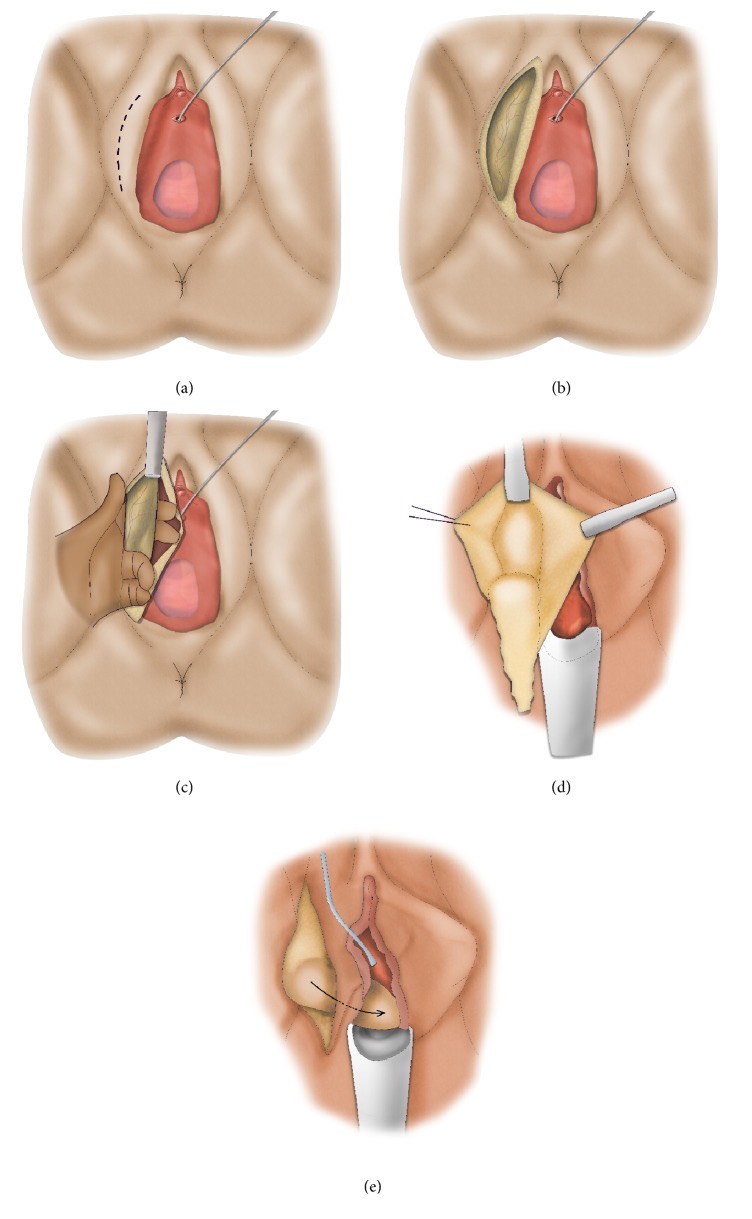
Martius flap harvest. (a, b) Sagittal incision at the most dependent line of the labium majus; (c, d) mobilization of the fibrofatty tissue; (e) transposition of the flap to the operative field through a subcutaneous tunnel. Drawn for urethroplasty; after urethrolysis the pad is placed between the freed urethra and the pubis. From Waterloos M, Verla W. Biomed Res Int. 2019;2019:6715257, Figure 11 (CC BY).[11]
Outcomes. Carey et al. reported resolution of obstruction in 20 of 23 women (87%) after urethrolysis with circumferential Martius wrapping (mean follow-up 15 months), with postoperative SUI reported in 6 of 23 women.[12] In 11 women with refractory obstruction after failed transvaginal urethrolysis, suprameatal urethrolysis with a Martius flap succeeded in 9 (82%) at a median of 10.8 months, and SUI recurred in 1.[9] Oliver and Raz believe Martius interposition is critical to prevent recurrent urethral fixation to the pubic bones.[9]
Postoperative Management
| Scenario | Catheter duration |
|---|---|
| Sling incision | Void trial before discharge; often immediate improvement[1] |
| Suprameatal urethrolysis with Martius flap | Urethral catheter ~5 days[9] |
| Inadvertent bladder injury with cystorrhaphy | Indwelling Foley 1–2 weeks[1] |
| Urethral / bladder injury visualized on completion cystoscopy | Catheter 2 weeks[1] |
| Inaccessible area of injury (no repair possible) | Foley 2–3 weeks for secondary healing; cystourethrogram may be obtained before removal at surgeon preference[1] |
Outcomes
- Voiding symptoms. Voiding or obstructive symptoms improve in up to 87% of patients after surgery for obstruction.[1] Retrospective series report distinct outcomes after different operations: Nitti and Raz found normal voiding in 29/41 women (71%) after urethrolysis with Raz bladder-neck resuspension; Carr and Webster reported complete symptom resolution or significant improvement after 73% of vaginal and 86% of retropubic procedures, with repeat suspension in 63% of procedures; Cross reported resolution of urge incontinence in 33/39 women (85%); Carey reported obstruction resolution in 20/23 women (87%) after urethrolysis with Martius wrapping.[1][2][6][10][12]
- Recurrent SUI. Simple sling incision is followed by recurrent SUI in about 20% (Moore and Goldman), and the reported range across series is 9–50%.[1][5] Recurrence is less frequent after incision of a fascial sling than of a synthetic midurethral sling (author experience).[1] Urethral bulking is one initial management option for recurrent SUI.[1]
- Persistent urge incontinence. Urge incontinence persists after sling incision in up to 70–80% in reported series, more often when treatment of the obstruction is delayed. It is managed with overactive bladder therapy.[1] In a separate single-center retrospective referral cohort of 105 women with chronic urinary symptoms after sling surgery, 59 underwent suburethral sling excision; among those treated, storage and voiding symptoms improved in 43% and 87%, respectively, at six months.[27]
- Preoperative predictors. A higher PVR predicted failure in Nitti and Raz (p = 0.021). In Petrou and colleagues’ 32-woman suprameatal urethrolysis series, preoperative maximum flow rate was associated with operative success (p = 0.018), while PVR and maximum detrusor pressure were not. Carr and Webster found no statistically significant predictor among the variables they examined.[2][4][10]
- Refractory obstruction. Suprameatal urethrolysis with a Martius flap has been described after failed transvaginal urethrolysis; 9/11 women (82%) could void voluntarily without catheterization or further obstruction surgery at median 10.8 months.[9]
Complications
Significant bleeding, urethral or bladder injury, and recurrent SUI are the principal complications.[5] Martius harvest can add labial morbidity: in a mixed-indication series of 97 women (60 with BOO), 5 reported labial pain, 13 numbness, and 9 labial distortion at mean 85-month follow-up.[26]
Timing
- Improving short-term voiding dysfunction after MUS placement can be managed expectantly for up to 6 weeks; retention or a large PVR warrants earlier assessment and consideration of intervention.[3] For acute retention after synthetic MUS, the 2024 French multisociety guideline recommends evaluating for a local cause and surgically relaxing the tape by direct approach in less than 7 days (Expert Agreement); preoperative detrusor hypocontractility may favor self-catheterization instead.[21]
- Timely treatment of obstruction gives symptom relief and may prevent long-term deterioration of the lower urinary tract.[1]
- In one cohort, resolution of lower urinary tract symptoms was higher when sling lysis was done within a year of the index surgery. In another, timing did not affect the risk of SUI requiring treatment.[1]
- Retention after autologous pubovaginal sling. Morgan et al. reported urethrolysis for hypersuspension in 5 of 247 PVS recipients but did not study revision timing.[20] Mahdy and Ghoniem describe their practice of observation with regular intermittent catheterization for up to 3 months after autologous rectus fascial sling, followed by sling incision with or without urethrolysis if retention persists.[22] Separately, cystoscope-assisted early loosening within 6 weeks has been described as successful in unquantified author experience (see Fascial Slings above).[16] The early-loosening and observation approaches have not been directly compared.
Decision Pearls
- MUS obstruction. For acute postoperative retention, the 2024 CUA guideline recommends 1–2 days of catheterization followed by another void trial; for persistent retention, early sling loosening within one week or sling incision at 4–6 weeks when possible (Clinical Principle).[24] The 2024 French guideline recommends direct tape relaxation in less than 7 days (Expert Agreement), except that self-catheterization may be proposed with preoperative detrusor hypocontractility.[21] For later obstruction, use sling incision or revision first; reserve formal urethrolysis for failed limited release or other etiologies.[1]
- Post-Burch or hypersuspension obstruction. Perform retropubic or transvaginal urethrolysis, not sling incision (no sling to transect).
- Martius flap interposition if redo dissection, severely scarred field, or concomitant urethrotomy is required.
- Counsel about recurrent SUI (about 20% after sling incision, up to 50% in some series) before any sling release; have a plan for staged retreatment (bulking, repeat sling, autologous PVS, or AUS) if recurrence occurs.[1]
- Female BOO diagnosis. Equivocal pressure-flow results do not exclude obstruction after continence surgery. Integrate the operative timeline and examination with cystourethroscopy and urodynamic evaluation, preferably with videofluoroscopy; the 2026 EAU guideline gives strong recommendations for these tests in suspected anatomical BOO and warns against relying on urine flow alone.[1][25]
See Also
- Retropubic Mid-Urethral Sling
- Transobturator Mid-Urethral Sling
- Single-Incision Mini-Sling
- Burch Colposuspension
- Vaginal Mesh & Graft Complications
- Female SUI clinical condition
Videos
References
1. Gleich LD, Goldman HB. Urethrolysis. Neurourol Urodyn. 2025;44(1):76–84. doi:10.1002/nau.25387
2. Carr LK, Webster GD. Voiding dysfunction following incontinence surgery: diagnosis and treatment with retropubic or vaginal urethrolysis. J Urol. 1997;157(3):821–3. doi:10.1016/s0022-5347(01)65054-7
3. Committee on Gynecologic Practice. Committee Opinion No. 694: Management of mesh and graft complications in gynecologic surgery. Obstet Gynecol. 2017;129(4):e102–e108. doi:10.1097/AOG.0000000000002022
4. Petrou SP, Brown JA, Blaivas JG. Suprameatal transvaginal urethrolysis. J Urol. 1999;161(4):1268–71. doi:10.1016/s0022-5347(01)61655-0
5. Moore CK, Goldman HB. Simple sling incision for the treatment of iatrogenic bladder outlet obstruction. Int Urogynecol J. 2013;24(12):2145–6. doi:10.1007/s00192-013-2241-5
6. Cross CA, Cespedes RD, English SF, McGuire EJ. Transvaginal urethrolysis for urethral obstruction after anti-incontinence surgery. J Urol. 1998;159(4):1199–201. doi:10.1016/s0022-5347(01)63554-7
7. Erdemoglu E, Öztürk V, Turan İ, Erdemoglu E. Vaginally assisted laparoscopic urethrolysis and mesh excision after tension-free vaginal tape. J Minim Invasive Gynecol. 2021;28(12):1975–1977. doi:10.1016/j.jmig.2021.06.024
8. Orasanu B, Marotte J, Pasko B, Hijaz A, Daneshgari F. Robotic-assisted urethrolysis for urethral obstruction after retropubic bladder neck suspension — a case series report. J Endourol. 2014;28(2):214–8. doi:10.1089/end.2013.0410
9. Oliver JL, Raz S. Suprameatal urethrolysis with Martius flap for refractory bladder outflow obstruction following stress incontinence surgery in females. Neurourol Urodyn. 2018;37(1):449–457. doi:10.1002/nau.23329
10. Nitti VW, Raz S. Obstruction following anti-incontinence procedures: diagnosis and treatment with transvaginal urethrolysis. J Urol. 1994;152(1):93–8. doi:10.1016/s0022-5347(17)32825-2
11. Waterloos M, Verla W. Female urethroplasty: a practical guide emphasizing diagnosis and surgical treatment of female urethral stricture disease. Biomed Res Int. 2019;2019:6715257. doi:10.1155/2019/6715257
12. Carey JM, Chon JK, Leach GE. Urethrolysis with Martius labial fat pad graft for iatrogenic bladder outlet obstruction. Urology. 2003;61(4 Suppl 1):21–5. doi:10.1016/s0090-4295(03)00117-1
13. Price N, Slack A, Khong SY, Currie I, Jackson S. The benefit of early mobilisation of tension-free vaginal tape in the treatment of post-operative voiding dysfunction. Int Urogynecol J Pelvic Floor Dysfunct. 2009;20(7):855-8. doi:10.1007/s00192-009-0858-1
14. Karram MM. Synthetic midurethral slings for the correction of stress incontinence. In: Baggish MS, Karram MM, eds. Atlas of Pelvic Anatomy and Gynecologic Surgery. 5th ed. Elsevier; 2021:713-752.
15. Sinha S. Bladder outlet obstruction after sling surgery for stress urinary incontinence. In: Khattar N, Nayyar R, Panda A, eds. Female Bladder Outlet Obstruction and Urethral Reconstruction. Springer; 2021:99-109. doi:10.1007/978-981-15-8521-0_9
16. Rourke EA, Reynolds WS, Brothers A, Osborn DJ, Dmochowski RR, Kaufman MR. Fascial slings. In: Cardozo L, Staskin D, eds. Textbook of Female Urology and Urogynecology. Vol 2: Surgical Perspectives. 5th ed. CRC Press; 2023:787-794.
17. Karram MM. Pubovaginal slings for the correction of stress incontinence. In: Baggish MS, Karram MM, eds. Atlas of Pelvic Anatomy and Gynecologic Surgery. 5th ed. Elsevier; 2021:763-778.
18. Karram MM. Retropubic urethropexy for stress incontinence and retropubic paravaginal repair. In: Baggish MS, Karram MM, eds. Atlas of Pelvic Anatomy and Gynecologic Surgery. 5th ed. Elsevier; 2021:419-431.
19. Sebesta EM, Kaufman MR, Reynolds WS, Mock S, Dmochowski RR. Diagnosis and treatment of obstruction following incontinence surgery. In: Cardozo L, Staskin D, eds. Textbook of Female Urology and Urogynecology. Vol 2: Surgical Perspectives. 5th ed. CRC Press; 2023:847-859. doi:10.1201/9781003144243-85
20. Morgan TO Jr, Westney OL, McGuire EJ. Pubovaginal sling: 4-year outcome analysis and quality of life assessment. J Urol. 2000;163(6):1845-8. doi:10.1016/s0022-5347(05)67557-x
21. Stivalet-Schoentgen N, Perrouin Verbe MA, Campagne-Loiseau S, et al. "Management of Complications of Prosthetic Mid-urethral Tape Surgery for Stress Urinary Incontinence in Women." Urology. 2024;194:43-51. doi:10.1016/j.urology.2024.08.064
22. Mahdy A, Ghoniem GM. "Autologous rectus fascia sling for treatment of stress urinary incontinence in women: A review of the literature." Neurourol Urodyn. 2019;38(Suppl 4):S51–S58. doi:10.1002/nau.23878
23. Anger JT, Amundsen CL, Webster GD. "Obstruction after Burch colposuspension: a return to retropubic urethrolysis." Int Urogynecol J Pelvic Floor Dysfunct. 2006;17(5):455–459. doi:10.1007/s00192-005-0037-y
24. Carlson K, Andrews M, Bascom A, et al. "2024 Canadian Urological Association guideline: Female stress urinary incontinence." Can Urol Assoc J. 2024;18(4):83–102. doi:10.5489/cuaj.8751
25. Harding CK, Lapitan MC, Arlandis S, et al. "EAU Guidelines on Non-neurogenic Female LUTS." EAU Guidelines. 2026. Full guideline
26. Lee D, Dillon BE, Zimmern PE. "Long-term morbidity of Martius labial fat pad graft in vaginal reconstruction surgery." Urology. 2013;82(6):1261–1266. doi:10.1016/j.urology.2013.08.032
27. Ross J, Avvakoumova L, Yassein A, et al. "Prevalence and predictors of bladder outlet obstruction in women with chronic urinary symptoms and a history of urethral sling surgery." J Urol. 2023;209(2):384–390. doi:10.1097/JU.0000000000003068