Musculocutaneous Latissimus Dorsi Flap Phalloplasty
Musculocutaneous latissimus dorsi (MLD) flap phalloplasty is total phallic construction with a free flap of back skin carried on a strip of latissimus dorsi muscle and the thoracodorsal pedicle. The flap gives a large-volume neophallus, a donor scar on the lateral trunk and enough tissue for staged urethral reconstruction and erectile prosthesis placement. Its main limitation is poor tactile sensation, because the thoracodorsal nerve is a motor nerve.[1][2][3] The published experience comes mainly from three centers (Belgrade, Brno and Moscow) and consists of retrospective single-center series and technique reports, none of which compares MLD directly with radial forearm free flap (RFFF) or anterolateral thigh (ALT) phalloplasty.[1][4]
The flap is also used for penile reconstruction outside gender-affirming surgery. The first Belgrade series reconstructed the penis for congenital anomalies, iatrogenic loss and traumatic loss, and the Moscow series of 592 latissimus dorsi phalloplasties included 56 reconstructions for posttraumatic penile loss, 17 after oncologic resection and 25 for congenital malformations.[5][4]
For cohort-level pathway selection, see Masculinizing Gender-Affirming Surgery. For the main soft-tissue alternatives, see RFFF Phalloplasty, ALT Phalloplasty and SCIP Phalloplasty; for a bone-bearing alternative, see Fibula Phalloplasty.
Indications
| Scenario | Fit for MLD Phalloplasty |
|---|---|
| Large phallic length and girth desired | Strong fit; the Belgrade flap is designed 11-15 cm wide and 13-18 cm long to match adult penile dimensions[3] |
| Visible forearm scar unacceptable | Strong fit; the donor scar lies on the lateral trunk and was closed directly in 120 of 160 Belgrade patients[3] |
| Planned erectile prosthesis | Strong fit; the flap volume accommodates prosthesis implantation, including inflatable and malleable devices[1][2] |
| Penile loss after trauma or oncologic resection; congenital penile insufficiency | Reported indication; the residual corporal stump can be mobilized and buried in the flap base[5][4] |
| Prior metoidioplasty or earlier genital gender-affirming surgery | Described; the Valada technique video case had a prior metoidioplasty[6][3] |
| Tactile phallic sensation is a priority | Weak fit; only 23 of 160 Belgrade patients reported tactile sensation of the neophallus[3] |
| Penetration without a prosthesis is the goal | Possible only in the motor-reinnervated variant, which produces voluntary contraction rather than erection[7][4] |
| Single-stage full-length urethra expected | Weak fit; back skin is usually too thick for immediate tube-in-tube urethroplasty, and urethral reconstruction is staged[4][3] |
Contraindications and Caution Zones
| Scenario | Counseling Point |
|---|---|
| Thick back subcutaneous fat or muscle | Higher risk of a bulky tube and tension on closure. The Moscow group thins the flap margin by up to 4 cm in patients of heavy build and reserves one-stage latissimus-only phallourethroplasty for patients of slender build. In the Valada technique, the ventral phallus is closed with a split-thickness skin graft when tissue is thick[4][6] |
| Microsurgery unavailable | MLD is a free flap and needs microvascular anastomosis[1] |
| Tactile sensation expected | Counsel that phallic tactile sensation is limited and that erogenous sensation depends on the clitoris incorporated at the phallic base[3][1] |
| Intraoperative repositioning | Harvest is done in lateral decubitus and recipient work supine; the Moscow group lists the positional changes as a limitation of the technique[4][6] |
| Serratus plane dissection | The long thoracic nerve is at risk during flap elevation; injury causes scapular winging[3] |
Historical Context
Adamyan and colleagues in Moscow report performing reinnervated latissimus dorsi phalloplasty from 1991 and first presenting it in 1993, with revascularization from the deep inferior epigastric vessels and motor reinnervation from the obturator nerve. They note that the method is usually attributed in the literature to Perovic.[4] Perovic, Djinovic, Bumbasirevic, Djordjevic and Vukovic reported 16 MLD total phalloplasties in 2007, performed between 1999 and 2006 for congenital, iatrogenic and traumatic penile insufficiency in patients aged 10 to 34 years.[5] In the same year, Vesely, Ranno and colleagues in Brno reported 22 reinnervated latissimus dorsi phalloplasties in gender-affirming surgery, designed to give voluntary contraction of the neophallus.[7]
The Belgrade group adopted MLD as its primary gender-affirming phalloplasty from 2007, reporting 129 patients treated to 2017 and an overlapping update of 160 patients treated to 2020.[2][3] A 2021 systematic review identified five MLD phalloplasty reports totaling 182 patients.[1]
Flap Anatomy
The latissimus dorsi has a dual blood supply: the thoracodorsal artery, a branch of the subscapular artery and the dominant vessel, and posterior paraspinous perforators. The thoracodorsal nerve arises from the posterior cord of the brachial plexus (C6-C8). The neurovascular hilum lies 8 to 9 cm from the axillary artery and runs 1.5 to 3.0 cm from the anterior edge of the muscle. The deep fascia is taken with a musculocutaneous flap because the skin is supplied through perforators.[3]
| Structure | Practical Relevance |
|---|---|
| Thoracodorsal artery and vein | Flap pedicle; dissected to the subscapular origin for length. In the Valada technique the artery is taken with a patch of subscapular artery[6][3] |
| Thoracodorsal nerve | Motor nerve. Coapted to the ilioinguinal nerve in the Belgrade technique, which gives little tactile sensation, or to a motor nerve such as the obturator nerve for voluntary contraction[8][5][4] |
| Muscle component | The Belgrade group takes only a narrow strip of muscle around the pedicle to reduce bulk and allow tubularization; the Moscow group keeps a muscle base of at least 8-10 cm with fibers along the long axis of the phallus[3][4] |
| Recipient vessels | Superficial femoral artery (end-to-side) and saphenous vein (end-to-end) in Belgrade; deep inferior epigastric artery and veins in Moscow[8][6][4] |
| Long thoracic nerve | Lies on serratus anterior in the dissection plane; protected to avoid scapular winging[3] |
Recipient-vessel outcomes have been pooled only across free-flap phalloplasty of all flap types, not for MLD flaps. In a 2026 systematic review and single-arm meta-analysis of 1,976 cases from 46 articles, the deep inferior epigastric artery was the recipient in 71.5% and the femoral artery in 28.5%, with pooled arterial and venous thrombosis rates of 2.0% and 2.2%. Femoral inflow through an interposition vein graft or arteriovenous loop was associated with arterial thrombosis in 16.0%, against 0.1% after direct femoral anastomosis and 1.2% after deep inferior epigastric anastomosis. Without vascular thrombosis, partial flap necrosis was less frequent after direct femoral anastomosis (0.6%) than after deep inferior epigastric anastomosis (6.2%).[9]
Technique
Belgrade First Stage
The Belgrade first stage combines genital preparation, urethral lengthening, scrotoplasty and free-flap phalloplasty in one operation.[3][10]
- Preparation. The nondominant side is used. The donor region is massaged preoperatively to improve skin elasticity for primary closure.[3][10]
- Genital stage (supine). Hysterectomy and oophorectomy, when not already done, are performed transvaginally or laparoscopically; concurrent hysterectomy, salpingo-oophorectomy and colpocleisis with MLD phalloplasty has also been described.[3][11] A flap of anterior vaginal wall is joined to the urethral plate to form the pars fixa. Flaps from the inner labia minora and clitoral skin are tubularized to lengthen the urethra. The labia majora are joined to form the scrotum and testicular implants are placed. A Y incision above the clitoris prepares the site for phallic fixation, and an inguinal incision exposes the femoral artery, saphenous vein and ilioinguinal nerve.[3][10]
- Positioning. Bencic et al. describe a lateral decubitus position with the upper torso at 90° and the pelvis tilted 30°, giving simultaneous access to the back and groin. In the Valada technique, the superficial femoral artery and saphenous vein are isolated supine first, the patient is turned to the lateral flank position for harvest, and then returned supine for transfer.[3][6]
- Flap design. The flap is marked from the anterior and superior muscle borders to 11-15 cm wide and 13-18 cm long. The glans is designed over the distal 5 cm, and a 1 cm strip between glans and shaft is de-epithelialized to imitate the coronal sulcus.[3]
- Elevation. The anterior skin margin is incised to the deep fascia and the plane between latissimus dorsi and serratus anterior is developed. The posterior intercostal perforators are divided and only a narrow strip of muscle around the pedicle is kept. The long thoracic nerve is protected.[3]
- Tubularization in situ. The neophallus is tubularized while still perfused on its pedicle. In the Valada technique, the inferior donor wound is also closed before the thoracodorsal artery and vein are divided, to shorten ischemia time. The pedicle is divided at the subscapular vessels for maximal length.[3][6]
- Donor closure. The donor site is closed directly; a split-thickness skin graft is used when direct closure is not possible.[3]
- Transfer and anastomosis. The thoracodorsal artery is anastomosed end-to-side to the femoral artery and the thoracodorsal vein end-to-end to the saphenous vein. The thoracodorsal nerve is coapted to the ilioinguinal nerve. The clitoris is incorporated at the phallic base, and the lengthened urethra is passed through a subcutaneous tunnel to a meatus, usually in the proximal phallus.[3][6][5]
- Thick tissue. When the muscle or subcutaneous fat is thick, a split-thickness skin graft can close the ventral phallus, reducing tension on the tube and providing a plate for later urethral lengthening.[6]
- Postoperative care. A suprapubic catheter is left for 3 weeks, followed by a 12-14 Ch urethral catheter for 2 weeks. Flap viability is monitored clinically and with a handheld Doppler, and a dressing keeps the phallus elevated to prevent pedicle kinking.[3]
Operative time in the single case of the Jun technique video was 427 minutes.[10]
Motor-Reinnervated Variant
The Brno and Moscow groups coapt the thoracodorsal nerve to a recipient motor nerve so that the transferred muscle can contract voluntarily.[7][4] In the Moscow technique:[4]
- The flap is harvested from the right side, and the left deep inferior epigastric vessels are dissected through a 10-12 cm contralateral pararectal incision and rotated through the external oblique aponeurosis to the phallic base.
- The motor branch of the obturator nerve is taken from an inner-thigh incision and passed through a subfascial tunnel to the anastomotic site.
- The flap is tubularized with the muscle fibers along the long axis of the phallus, and the external meatus and coronal sulcus are imitated at the first operation.
- The flap is not left perfused on its pedicle while the back is closed; donor closure (35-40 minutes) and flap modelling are done in parallel.
- The muscular base is fixed to the pubic periosteum.
- After traumatic penile loss, the corporal stump is mobilized by dividing the suspensory ligaments (reported gain 3-4 cm) and inserted into the flap base, and the urethral stump is brought out as a fistula on the ventral phallus for later urethroplasty.
- Muscle activity is assessed at 12 months; an erectile prosthesis is offered when reinnervation fails or contraction is insufficient for penetration.
Later Stages
In Belgrade, the second stage begins 6-9 months after the first. The remaining phallic urethra is built with staged buccal mucosa grafts (2-6 cm long and 1.4-2.2 cm wide), later tubularized with a second covering layer. Glansplasty uses the Norfolk technique. The prosthesis, inflatable or malleable, is placed through an infrapubic or penoscrotal approach with the proximal cylinder fixed to the pubic symphysis or periosteum, the pump in the neoscrotum and the reservoir paravesical. Patients who request it can have the clitoral glans de-epithelialized and covered at this stage. Final urethral caliber after all stages was 14 Ch.[3] The original Belgrade series used two- or three-stage buccal mucosa urethroplasty in 11 of 16 patients.[5]
Expert opinion in a narrative review of erectile device insertion after phalloplasty (all flap types) is to delay insertion at least 3-6 months after the preceding surgery and to complete urethral repair and glansplasty at least 6 months before.[12] See Penile Implant After Phalloplasty.
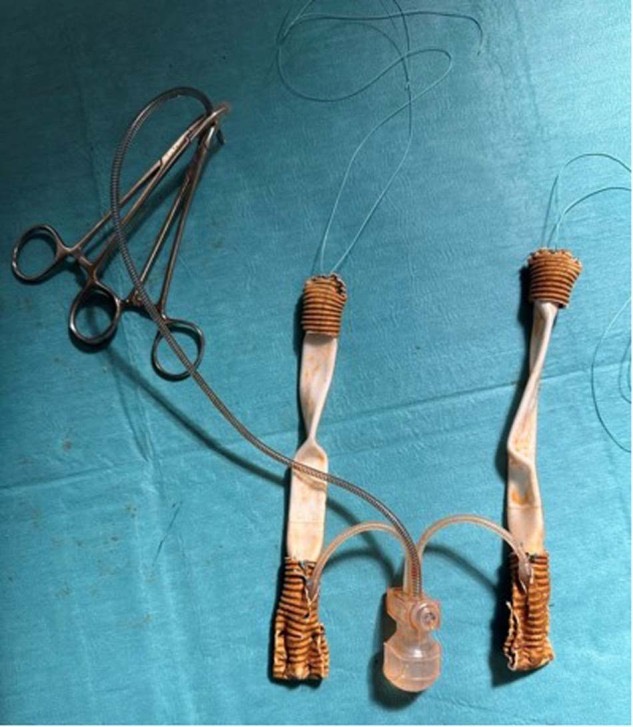
Preparing a three-piece inflatable prosthesis for a neophallus, which lacks tunica albuginea. A polyethylene terephthalate (Dacron) vascular graft forms a rear sheath over the proximal cylinder, to be anchored to the pubic bone, and a cap over the distal tip to reduce distal erosion; both are fixed with 2-0 nylon. The technique is described for phalloplasty in general, not specifically for MLD flaps. From Chiriaco G, et al. Int J Impot Res. 2023;35(7):664-671, Fig. 4 (CC BY 4.0).[12]
Urethral Strategies
| Strategy | Description | Reported Use |
|---|---|---|
| Genital-flap lengthening, then staged buccal mucosa | First-stage pars fixa and labia minora and clitoral skin flaps bring the meatus to the phallic base or proximal shaft; the pendulous urethra is completed with staged buccal mucosa grafts | Belgrade: mean first-stage urethral length 15.8 cm (range 13.4-21.7; n = 129), reaching the proximal third or midshaft in 91%; staged buccal mucosa urethroplasty in 95 of 160[2][3] |
| Shaft-only MLD, second-stage RFFF urethra | Latissimus shaft first; radial forearm flap urethra at least 3-4 months later | Moscow: 278 of 592[4] |
| One-stage latissimus-only phallourethroplasty | Urethra built from the latissimus flap itself | Moscow: 18 of 592, limited to patients of slender build[4] |
| Shaft-only without pendulous urethra | Perineal or proximal urethral opening; external meatus imitated cosmetically | Moscow: 284 of 592; the authors report that a convincing imitation meatus may lead about 20% of patients to forgo the second urethroplasty. Nasır performed no pendulous urethral reconstruction in 30 patients[4][13] |
Across phalloplasty generally, an expert-opinion review by Berli, Monstrey, Safa and Chen describes the three most common urethral strategies: single-stage phalloplasty with full-length urethroplasty, two-stage phalloplasty with a metoidioplasty-first approach, and two-stage phalloplasty with a phalloplasty-first (Big Ben) approach.[14]
See Pars Fixa Urethra and Prelaminated BMG Phallic Urethra for the urethral techniques in detail.
Outcomes
Published Series
All series are retrospective and single-center. The two Belgrade reports overlap and should not be added together.
| Series | Design, n, Follow-Up | Indication | Main Findings |
|---|---|---|---|
| Perovic 2007, Belgrade[5] | Retrospective, 16; mean 31 months (12-74) | Congenital 12, iatrogenic 2, traumatic 2; age 10-34 | Phallus 14-18 cm long and 11-15 cm in circumference; no partial or total flap necrosis; moderate donor scarring in 3; 2 urethrocutaneous fistulas (1 closed spontaneously); prosthesis in 7 |
| Vesely 2007, Brno[7] | Retrospective, 22; 11-44 months | Gender-affirming, motor-reinnervated | All flaps survived; hematoma 7, vascular thrombosis 2, partial necrosis 1, excessive swelling 3, donor-site graft loss 1. Of 19 evaluated, 18 (95%) could contract the muscle and 8 (42%) had intercourse by contracting it |
| Djordjevic 2019, Belgrade[2] | Retrospective, 129; mean 43 months (13-137) | Gender-affirming; age 20-53 | 1 partial and 2 total flap necroses; mean phallus 14.6 cm long and 12.4 cm in girth; standing voiding in all; 6 urethral fistulas and 2 strictures, repaired by minor revision; 39 malleable and 22 inflatable prostheses |
| Bencic 2022, Belgrade (overlapping update)[3] | Retrospective, 160; mean 52 months (6-152) | Gender-affirming | Mean phallus 15.2 cm (11-21) long and 12.4 cm in girth; 1 partial and 2 total necroses; standing voiding in 147; after the first stage, 10 fistulas and 4 strictures; after staged neophallic urethroplasty (n = 95), 30 fistulas, 10 of which closed spontaneously; prosthesis in 82 |
| Adamyan 2023, Moscow[4] | Retrospective, 592; mean 15 years (minimum 1) | Gender-affirming 470, intersex 24, congenital 25, oncologic 17, posttraumatic 56 | 8 total and 29 partial flap losses; 197 complications recorded, including 47 urethrocutaneous fistulas, 4 urethral stenoses and 43 donor-site complications; reinnervation in 91%, on average 6-9 months after surgery |
The Moscow authors report that about 90% of their complications occurred while the technique was being learned.[4] The Belgrade group observed slight muscle atrophy without loss of phallic dimensions and suggests that muscle-based flaps retract less than fasciocutaneous forearm flaps; this has not been tested comparatively.[3]
Sensation and Sexual Function
| Domain | Evidence |
|---|---|
| Tactile sensation | Thoracodorsal-to-ilioinguinal coaptation gives poor tactile sensation; 23 of 160 Belgrade patients reported tactile sensation, attributed to the incorporated clitoris and labial urethra[3] |
| Erogenous sensation | Reported by all 160 Belgrade patients through the clitoris incorporated at the phallic base, with its dorsal neurovascular bundle preserved[3][1] |
| Sensory reinnervation in motor variant | Not observed in any Moscow patient[4] |
| Voluntary contraction | Brno: onset at a mean of 4.1 months in 18 patients; in 14 examined, contraction shortened the phallus by a mean 3.08 cm and increased circumference by 4 cm, and the mean weight lifted was 1,129 g. The authors describe this as a "paradox" erection with stiffening, widening and shortening[7][15][16] |
| Penetration without prosthesis | Brno: 8 of 19 by muscle contraction. Belgrade (non-reinnervated): 17 of 160. Moscow: 80% satisfied with erectile function after reinnervation, by a simple patient survey[7][3][4] |
| Penetration with prosthesis | Feasible in all Belgrade patients with a prosthesis[3] |
Erectile Prosthesis
In the Belgrade update, 82 of 160 patients received a prosthesis (53 malleable). Six devices were removed for infection or skin perforation, and three inflatable devices were replaced for malfunction.[3] Nasır reported that the latissimus flap provides a structure into which a prosthesis can be inserted easily, in a series of 30 penile reconstructions.[13]
Pooled prosthesis data after phalloplasty are dominated by RFFF and are not MLD-specific. A meta-analysis of nine studies in transmasculine patients reported overall complication rates of 38% for inflatable and 37% for malleable devices, with explantation rates of 19% and 13%.[17] A narrative review reported 5-year inflatable device retention of 42-78% after flap phalloplasty.[18] A second narrative review summarizes a single-center series of 247 patients in which device survival in the neophallus was 72-79% at 25 months and 51-59% at 50 months. Devices in abdominal-flap phalloplasties needed revision more often than those in RFFF phalloplasties; the postulated reasons were the lack of phallic sensation and the more frequent need for two cylinders in a wide phallus, with wear from both cylinders and the weight of the phallus.[12] The MLD series cited here report device counts, removals and replacements but not device survival over time.
Complications
| Complication | MLD-Specific Data |
|---|---|
| Total flap loss | 2 in the Belgrade series (129 and 160 patients), both from venous thrombosis and reconstructed again with an ALT flap and a contralateral MLD flap; 8 of 592 in Moscow, 6 redone with a contralateral latissimus flap; none in 16 (Perovic) or 22 (Brno)[2][3][4][5][7] |
| Partial flap necrosis | 1 of 129 (Belgrade); 29 of 592 (Moscow); 1 of 22 (Brno)[2][4][7] |
| Hematoma | 7 of 22 (Brno); 14 in the Moscow series[7][4] |
| Urethral fistula and stricture | Belgrade 2019: 6 fistulas and 2 strictures in 129, repaired by minor revision (stage not specified in the abstract). Belgrade 2022: 10 fistulas and 4 strictures in 160 after first-stage lengthening, and 30 fistulas in 95 after staged neophallic urethroplasty. Moscow: 47 fistulas and 4 stenoses in 592[2][3][4] |
| Donor site | Moderate scarring in 3 of 16 (Perovic); skin graft loss in 1 of 22 (Brno); 43 donor-site complications in 592 (Moscow); split-thickness grafting needed in 40 of 160 (Belgrade)[5][7][4][3] |
| Phallic scar deformity with curvature | 26 in the Moscow series[4] |
| Prosthesis | 6 removals and 3 inflatable-device replacements in 82 implanted (Belgrade)[3] |
None of the series reviewed here reports validated shoulder-function measures after harvest.
Donor-site function data come from latissimus dorsi reconstruction outside phalloplasty. A systematic review of 22 studies (719 flaps in 644 patients; 7 prospective and 15 retrospective cohorts) found donor-site discomfort of any kind in 94 of 232 patients (41%) with questionnaire data. Nine of 13 studies reported some limitation of shoulder motion, mainly in the early postoperative period, and 8 of 12 reported some loss of shoulder strength, most often in extension, adduction and internal rotation; muscle-sparing latissimus and thoracodorsal artery perforator flaps had low functional morbidity.[19] In a single-center comparison of 22 patients per group, full latissimus dorsi flaps were associated with worse DASH, SPADI and ASES scores than split flaps preserving the anterior branch of the thoracodorsal nerve, and 7 patients after full flaps had less than MRC grade 5 shoulder power, against none after split flaps.[20] In a retrospective cohort of 90 patients followed for a median of 108 months, 17.8% reported donor-site pain, 10.0% dysesthesia and 2.2% subjective weakness; patients with pain or dysesthesia had shorter follow-up than those without, which the authors interpret as improvement over time.[21]
Comparison With RFFF and ALT
| Feature | MLD | RFFF | Pedicled ALT |
|---|---|---|---|
| Microsurgery | Required | Required | Usually not required |
| Donor site | Lateral trunk; usually closed directly | Visible forearm; grafted | Concealed thigh |
| Phallic volume | Large; designed to adult dimensions | Thin; Belgrade authors note a small forearm phallus sometimes cannot take two cylinders[3] | Often bulky; debulking common |
| Tactile sensation | Poor (23 of 160) | Reported by 86% in a 115-patient series[22]; in a prospective pilot with serial pressure testing, 6 of 8 had sensation at the latest measurement, at a mean 73 days[23] | Variable |
| Urethra | Genital-flap lengthening plus staged buccal mucosa, or second-flap urethra | Single-flap tube-in-tube | Staged or separate flap; multiple stages and revisions are often needed.[24] One-stage pedicled ALT with an RFFF urethra: long-term urinary complications in 10 of 19, 9 of them strictures[25] |
| Voluntary rigidity | Possible with motor reinnervation | No | No |
| Evidence base | Few centers, retrospective | Largest literature | Comparative cohorts against RFFF[26] |
RFFF remains the most widely used flap: it accounted for 65.3% of 2,586 patients in a 2026 systematic review of gender-affirming phalloplasty.[27] Garaffa, Christopher and Ralph reported 115 RFFF phalloplasties with 3 flap losses, sensation in 86% and 97% satisfaction with cosmesis and size.[22] A review from the same London group considers RFFF the best option for function, sensation and cosmesis, at the cost of a disfiguring scar and multiple stages.[28] In a single-center cohort of 213 patients, pedicled ALT had higher odds of urethral fistula than RFFF (OR 2.50).[26] A 2025 systematic review of 19 observational studies (769 patients: 614 RFFF, 155 pedicled ALT) found flap failure in 1.9% and 0.6% (P = 0.348) and satisfaction in 78% and 76.2%, and rated the evidence low by GRADE.[29] In a 57-patient single-center cohort, urethral fistula followed 48% of RFFF, 20% of pedicled ALT and 9.1% of pedicled abdominal-flap phalloplasties.[30] Neither study included MLD flaps.
Urethral complication rates are not directly comparable across flaps. The Belgrade first-stage counts (10 fistulas and 4 strictures in 160) describe proximal lengthening only; staged neophallic urethroplasty added 30 fistulas in 95 patients.[3] A meta-analysis of 21 studies (1,566 patients) across phalloplasty urethral techniques reported a pooled urethral fistula or stenosis rate of 48.9%.[31]
Evidence Gaps
- MLD data come from retrospective single-center series, mostly from Belgrade, Brno and Moscow, and the Belgrade reports overlap.[7][3][4][13]
- None of the MLD series compares it with RFFF or ALT using the same outcome definitions.
- Belgrade "standing voiding" includes patients voiding from a meatus at the phallic base, so it is not equivalent to voiding from the tip.[3]
- Motor reinnervation outcomes come from two groups; the Moscow functional outcome was a simple patient survey.[7][15][4]
- Across phalloplasty, a systematic review of neurorrhaphy (28 articles, 178 patients) found that sensation improved with nerve coaptation, but the number of coaptations, the coaptation technique and the donor and recipient nerves varied, and sensory outcomes were mostly reported as presence or absence of sensation.[32]
- Outcome reporting across phalloplasty studies is inconsistent for urinary function, tactile and erogenous sensation and cosmesis.[27] The GenderCOS consensus (2026) recommended outcome measurement instruments for 19 of the 20 core outcomes of genital gender-affirming surgery.[33]
Operative Pearls
- Prepare the recipient vessels before harvest to shorten ischemia time.
- Design the glans and coronal sulcus on the flap at harvest.
- Keep only a narrow muscle strip when bulk is the concern; keep a broader, longitudinally oriented muscle base when motor reinnervation is the goal.
- Dissect the pedicle to the subscapular origin for length.
- Protect the long thoracic nerve in the serratus plane.
- Close the ventral phallus with a skin graft rather than under tension when the tissue is thick.
- Keep the phallus elevated after surgery to avoid pedicle kinking.
- Counsel before surgery that tactile sensation is limited and that the urethra is completed in later stages.
See Also
- Masculinizing Gender-Affirming Surgery
- RFFF Phalloplasty
- ALT Phalloplasty
- SCIP Phalloplasty
- Fibula Phalloplasty
- Pars Fixa Urethra
- Penile Implant After Phalloplasty
- Revision and Salvage GAS
- Penile and Glans Replantation
- Genitourinary Vascularized Composite Allotransplantation
References
1. Kojovic V, Marjanovic M, Radenkovic A, Ilic P, Simic R, Bojovic B. Latissimus dorsi free flap phalloplasty: a systematic review. Int J Impot Res. 2021;33(7):746-753. doi:10.1038/s41443-020-00371-x
2. Djordjevic ML, Bencic M, Kojovic V, et al. Musculocutaneous latissimus dorsi flap for phalloplasty in female to male gender affirmation surgery. World J Urol. 2019;37(4):631-637. doi:10.1007/s00345-019-02641-w
3. Bencic M, Stojanovic B, Bizic M, Djordjevic ML. Musculocutaneous latissimus dorsi phalloplasty. Indian J Plast Surg. 2022;55(2):162-167. doi:10.1055/s-0041-1740382
4. Adamyan RT, Startseva OI, Gabriyanchik MA. 30 years of experience in musculocutaneous latissimus dorsi flap phalloplasty with reinnervation: optimal principles. Plast Reconstr Surg Glob Open. 2023;11(4):e4963. doi:10.1097/GOX.0000000000004963
5. Perovic SV, Djinovic R, Bumbasirevic M, Djordjevic M, Vukovic P. Total phalloplasty using a musculocutaneous latissimus dorsi flap. BJU Int. 2007;100(4):899-905. doi:10.1111/j.1464-410X.2007.07084.x
6. Valada A, Purohit RS, Djordjevic ML. Musculocutaneous latissimus dorsi phalloplasty: technique and tips. Urology. 2024;183:e323-e324. doi:10.1016/j.urology.2023.10.010
7. Vesely J, Hyza P, Ranno R, et al. New technique of total phalloplasty with reinnervated latissimus dorsi myocutaneous free flap in female-to-male transsexuals. Ann Plast Surg. 2007;58(5):544-550. doi:10.1097/01.sap.0000245123.16757.15
8. Dennis M, Granger A, Ortiz A, et al. The anatomy of the musculocutaneous latissimus dorsi flap for neophalloplasty. Clin Anat. 2018;31(2):152-159. doi:10.1002/ca.23016
9. Gaston J, Fodor R, Rampazzo A, Fascelli M, Gharb BB. Recipient vessel selection in free flap phalloplasty: a systematic review and single-arm meta-analysis. Microsurgery. 2026;46(5):e70251. doi:10.1002/micr.70251
10. Jun MS, Pušica S, Kojovic V, et al. Total phalloplasty with latissimus dorsi musculocutaneous flap in female-to-male transgender surgery. Urology. 2018;120:269-270. doi:10.1016/j.urology.2018.06.032
11. Djinovic R, Slavkovic M. Musculocutaneous latissimus dorsi phalloplasty with concurrent hysterectomy, salpingo-oophorectomy, and colpocleisis in gender-affirming surgery. J Sex Med. 2026;23(1):qdaf331. doi:10.1093/jsxmed/qdaf331
12. Chiriaco G, Looney A, Christopher AN, Ralph D, Lee WG. Erectile device insertion following phalloplasty in transgender and non-binary individuals assigned female at birth: a narrative review. Int J Impot Res. 2023;35(7):664-671. doi:10.1038/s41443-023-00764-8
13. Nasır S. Penis reconstruction with latissimus dorsi flap and challenges for penis prosthesis in phalloplasty. Ann Plast Surg. 2025;94(5):552-560. doi:10.1097/SAP.0000000000004241
14. Berli JU, Monstrey S, Safa B, Chen M. Neourethra creation in gender phalloplasty: differences in techniques and staging. Plast Reconstr Surg. 2021;147(5):801e-811e. doi:10.1097/PRS.0000000000007898
15. Ranno R, Veselý J, Hýza P, et al. Neo-phalloplasty with re-innervated latissimus dorsi free flap: a functional study of a novel technique. Acta Chir Plast. 2007;49(1):3-7. PMID:17469438
16. Ranno R, Hýza P, Veselý J, Dessy LA, Kadanka Z. An objective evaluation of contraction power of neo-phallus reconstructed with free re-innervated LD in female-to-male transsexuals. Acta Chir Plast. 2007;49(1):8-12. PMID:17469439
17. Fraiman E, Nandwana D, Loria M, et al. Complication and explantation rates of penile prostheses in transmasculine patients: a meta-analysis. Urology. 2024;194:260-268. doi:10.1016/j.urology.2024.08.022
18. Kocjancic E, Jaunarena JH, Schechter L, Acar Ö. Inflatable penile prosthesis implantation after gender affirming phalloplasty with radial forearm free flap. Int J Impot Res. 2020;32(1):99-106. doi:10.1038/s41443-019-0153-8
19. Lee KT, Mun GH. A systematic review of functional donor-site morbidity after latissimus dorsi muscle transfer. Plast Reconstr Surg. 2014;134(2):303-314. doi:10.1097/PRS.0000000000000365
20. Oberhofer HM, Samant SS, Swan CC, et al. Objective comparison of donor-site morbidity following full and thoracodorsal nerve-preserving split latissimus dorsi flaps. Plast Reconstr Surg. 2022;149(5):966e-971e. doi:10.1097/PRS.0000000000009022
21. Akça B, Menkü Özdemir FD, Üstün GG. Long-term patient-reported donor-site complaints after latissimus dorsi flap reconstruction: a 20-year cohort. J Craniofac Surg. Published online September 10, 2026. doi:10.1097/SCS.0000000000013362
22. Garaffa G, Christopher NA, Ralph DJ. Total phallic reconstruction in female-to-male transsexuals. Eur Urol. 2010;57(4):715-722. doi:10.1016/j.eururo.2009.05.018
23. Hu S, Oles N, Reiche E, et al. Early penile and donor site sensory outcomes after innervated radial forearm free flap phalloplasty: a pilot prospective study. Microsurgery. 2024;44(6):e31228. doi:10.1002/micr.31228
24. Xu KY, Watt AJ. The pedicled anterolateral thigh phalloplasty. Clin Plast Surg. 2018;45(3):399-406. doi:10.1016/j.cps.2018.03.011
25. van der Sluis WB, Smit JM, Pigot GLS, et al. Double flap phalloplasty in transgender men: surgical technique and outcome of pedicled anterolateral thigh flap phalloplasty combined with radial forearm free flap urethral reconstruction. Microsurgery. 2017;37(8):917-923. doi:10.1002/micr.30190
26. Ascha M, Massie JP, Morrison SD, Crane CN, Chen ML. Outcomes of single stage phalloplasty by pedicled anterolateral thigh flap versus radial forearm free flap in gender confirming surgery. J Urol. 2018;199(1):206-214. doi:10.1016/j.juro.2017.07.084
27. Tinajero JD, Liang DGK, Wasay S, Djordjevic ML, Di Taranto G. The evolution of phalloplasty for masculinizing gender affirming surgery: a systematic review of surgical techniques and complications over the past 25 years. Microsurgery. 2026;46(6):e70273. doi:10.1002/micr.70273
28. Kristinsson S, Johnson M, Ralph D. Review of penile reconstructive techniques. Int J Impot Res. 2021;33(3):243-250. doi:10.1038/s41443-020-0246-4
29. Netshiongolwe T, Mitchell S, Kathiravelupillai S, et al. Pedicled flaps versus free radial forearm flap for phalloplasty in female to male gender-confirming surgery: a systematic review. Ann Plast Surg. 2025;95(6):661-666. doi:10.1097/SAP.0000000000004502
30. Wang E, Cleff B, Basta A, et al. Flap choice in gender affirming phalloplasty affects postoperative complication rates. Microsurgery. 2026;46(1):e70154. doi:10.1002/micr.70154
31. Hu CH, Chang CJ, Wang SW, Chang KV. A systematic review and meta-analysis of urethral complications and outcomes in transgender men. J Plast Reconstr Aesthet Surg. 2022;75(1):10-24. doi:10.1016/j.bjps.2021.08.006
32. Ferrin PC, Burghardt E, Xu J, Peters BR. Optimizing neurorrhaphy to improve sensation in phalloplasty: a systematic review. Int J Impot Res. 2026;38(4):324-332. doi:10.1038/s41443-025-01021-w
33. Angelini M, Roijer PJ, Vallinga MS, et al. Outcome measurement instruments for the core outcome sets on genital gender-affirming surgery: the GenderCOS project. EClinicalMedicine. 2026;95:103907. doi:10.1016/j.eclinm.2026.103907